
Motorized Blinds Canada: Ultimate 2026 Guide
You're probably here because your current blinds are doing at least one annoying thing every day. The cords tangle, the sun hits the TV at the wrong time, one tall window is hard to reach, or you keep opening and closing the same shades morning and night.
That's usually the point where motorized blinds stop sounding like a gadget and start sounding practical. In Canadian homes, they're often less about showing off a smart home and more about easier light control, safer cordless operation, and better day-to-day comfort through changing seasons.
For anyone shopping for motorized blinds in Canada, the main questions are usually simple. What do they cost, what power option makes sense, will they work in an older home, and are they worth it for a family space, condo, or rental.
Table of Contents
- Welcome to Effortless Light Control
- Why Upgrade to Motorized Blinds
- Choosing Your Power and Control Options
- Smart Home Integration and Canadian Safety Standards
- Understanding the Costs of Motorized Blinds
- Installation Process and Long-Term Maintenance
- Why Choose a Canadian Installer Like Blinds Hut
Welcome to Effortless Light Control
Manual blinds ask you to do the same small job over and over. Open them in the morning, tilt them at noon, lower them for privacy at night, then fix the one shade that stopped halfway because the cord snagged again.
Motorized blinds clean that up. You press a remote, tap an app, use a wall control, or set a schedule, and the blinds move the way they should.
That sounds simple, but simple is the point. In a Canadian home, the upgrade often helps with awkward windows, bright summer glare, privacy after dark, and spaces where cords are a bad fit.
A lot of homeowners also get stuck on one false choice. They think motorized means fully smart, fully wired, and fully complicated.
It doesn't.
Some setups are built for renovations and new builds. Others are much better for retrofits, condos, rentals, and older houses where opening walls isn't realistic.
A good motorized setup should match the room first, not the trend.
If you're comparing options for motorized blinds in Canada, it helps to think like an installer. Start with the window, then the power source, then the control method, then the fabric and finish. That order keeps the project practical and keeps surprises off the quote.
Why Upgrade to Motorized Blinds
It usually starts with one frustrating window.
A stairwell shade stays half-open because no one wants to fetch a ladder. The blinds over the patio door get left alone all week because opening and closing them feels like one more small task. In a nursery or child's bedroom, cords can feel like something you would rather not have at all.
That is where motorization earns its keep in a Canadian home. It solves everyday window problems in a way that feels practical, not flashy.
Better use of the windows you already have
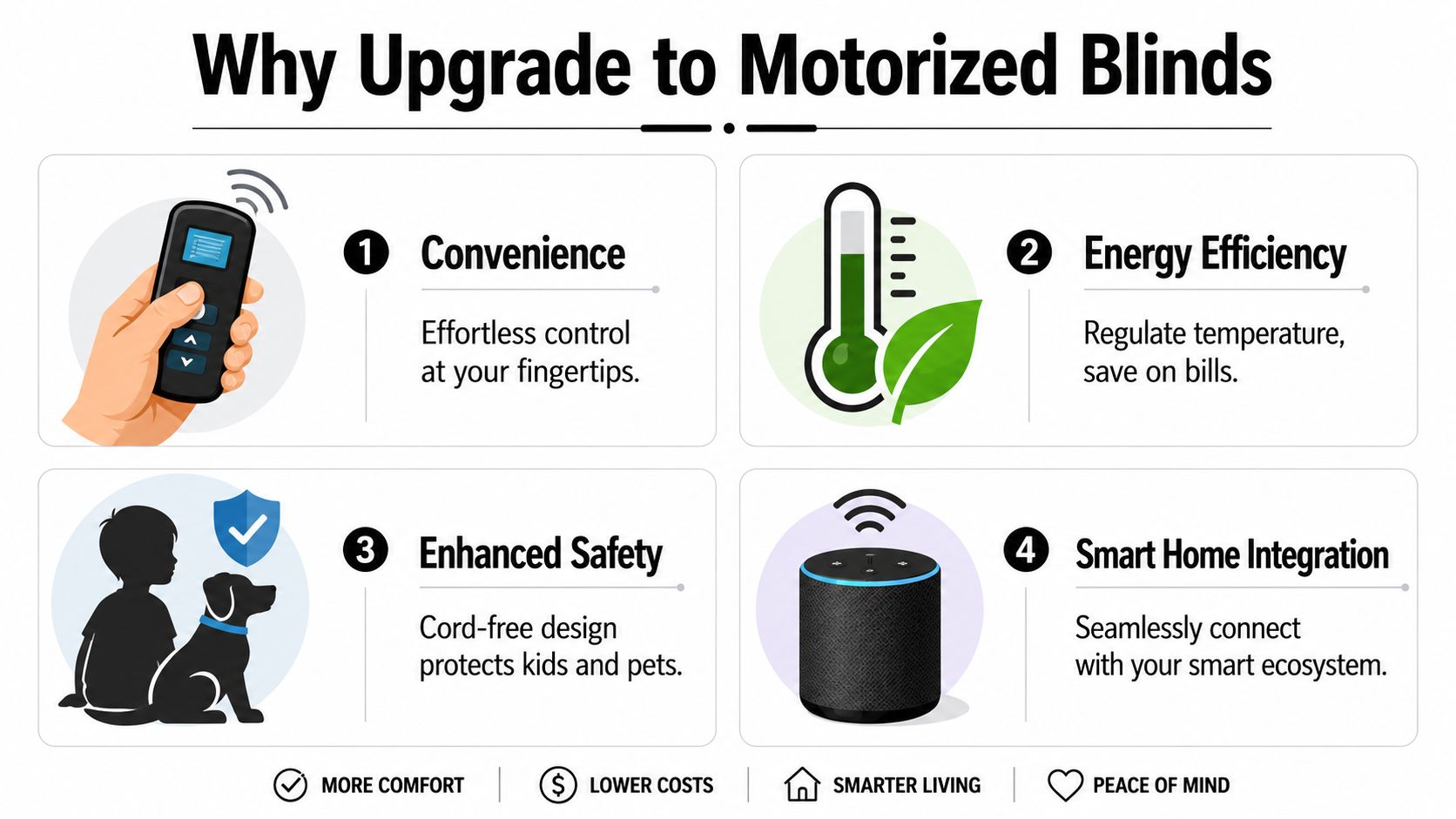
The biggest upgrade is often consistency. When blinds are easy to use, they get used properly. Rooms stay more comfortable, glare is easier to manage, and privacy is less of an afterthought at night.
This matters most on the windows that are awkward by design. Tall windows, wide front-facing windows, patio doors, and home office windows all tend to be the ones people ignore with manual operation. A motor lets you adjust them in seconds, so the shade finally works the way it was meant to.
If you want a simple setup without jumping straight into full smart-home controls, a remote control option for motorized blinds is often the easiest place to start.
More comfort through Canadian seasons
Windows do more than let in light. They also bring in summer glare, winter chill, and those shoulder-season temperature swings that make one room feel fine and another feel drafty.
Motorized blinds help because they are more likely to be adjusted at the right time of day. Close them during intense afternoon sun, and a west-facing room can feel calmer and easier to cool. Lower insulated shades after dark in winter, and the room often feels less exposed to cold glass. The blind is not replacing your furnace or air conditioner. It works more like a lid on a pot. It helps keep indoor conditions steadier.
That practical habit matters more in Canada than a lot of showroom talk suggests.
Safety and access are real reasons to upgrade
For families, cordless operation is often one of the strongest reasons to switch. Fewer exposed cords means fewer everyday hazards around children and pets, and it also gives the window a cleaner look.
There is also a clear accessibility benefit.
- For tall or hard-to-reach windows: You can adjust the shade without a ladder, reach pole, or stretching.
- For older adults or anyone with limited mobility: Daily operation is easier on hands, shoulders, and grip strength.
- For shared rooms: Everyone can use the blinds the same way without learning a finicky cord or chain.
- For a tidier finish: The window looks more uniform because there are no cords hanging at uneven lengths.
In other words, motorization is often less about technology and more about removing friction from daily life. That is why many Canadian homeowners choose it even when they have no interest in voice assistants or elaborate automation.
Choosing Your Power and Control Options
Many buyers encounter a common challenge: they hear “motorized” and assume there's only one type.
There isn't. The smartest choice depends on whether you're building new, renovating, or adding shades to an existing home with finished walls.
Power first, controls second
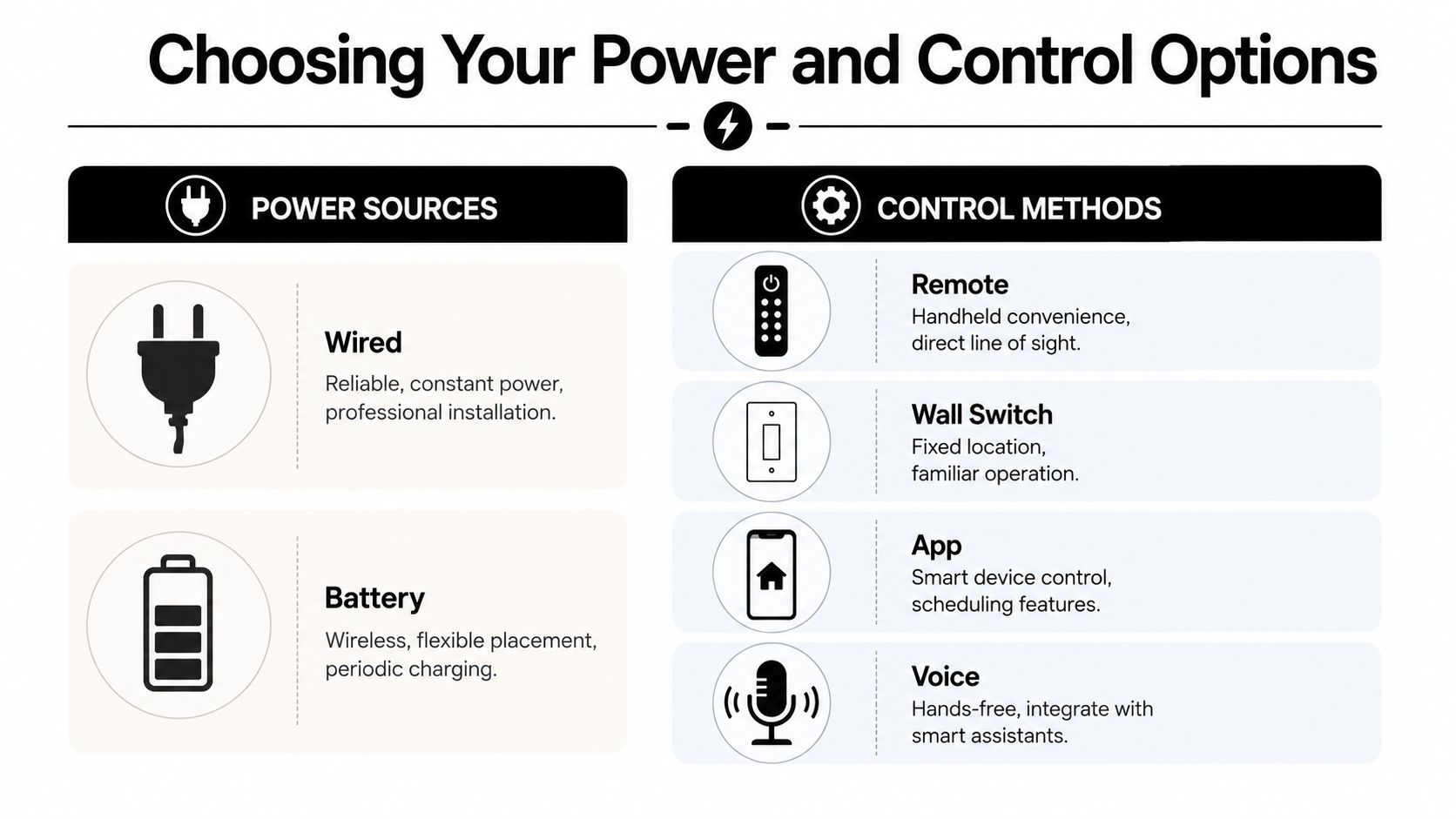
For most retrofit jobs, battery-powered blinds are the easiest starting point. They avoid wall work, they suit many existing windows, and they're often a comfortable fit for condos, rentals, and older homes.
Hardwired systems make the most sense when an electrician is already involved or the walls are open. In that setting, permanent power can be a clean long-term solution.
Solar-assisted options can also be worth a look where the window gets suitable light and you want to reduce charging or battery maintenance. Whether they're practical depends heavily on the placement and room conditions.
North America leads this market because of strong smart-home adoption, but the more useful takeaway for Canadian buyers is simpler. As noted in Mordor Intelligence's discussion of automated blinds and retrofit-friendly choices, the decision is often between hardwiring, battery operation, and other retrofit-friendly options, especially in older housing stock and rentals.
Power Source Comparison
| Feature | Battery-Powered | Hardwired | Solar-Powered |
|---|---|---|---|
| Installation style | Great for retrofit projects | Best during construction or major renovation | Often retrofit-friendly depending on window location |
| Wall access needed | Usually minimal | Usually yes | Usually minimal |
| Best fit | Older homes, condos, rentals | New builds, large planned projects | Sunny placements where reduced charging is a priority |
| Maintenance style | Periodic charging or battery service | Less day-to-day power handling | Panel placement and light exposure matter |
How people actually control them
Once power is sorted out, control is easy to understand. Most homeowners choose one or more of these:
- Remote control: Fast and familiar. Good for living rooms and bedrooms.
- Wall switch: Feels natural to guests and works well near patio doors.
- App control: Useful when you want schedules or whole-home control.
- Voice control: Handy when your hands are full or blinds are grouped.
If you want a clearer example of how handheld operation works in real homes, this remote-controlled motorized blinds page shows the type of setup many buyers start with before adding deeper smart features.
Practical rule: Choose the power system based on the house, then choose the control method based on your routine.
Smart Home Integration and Canadian Safety Standards
A motorized blind becomes “smart” when it can do more than move up and down on command. It can follow a schedule, join a scene with other devices, or respond to voice control through a compatible smart-home system.
That can be as simple as lowering bedroom shades at night or opening a main-floor room in the morning. In day-to-day use, smart features are most helpful when they remove repetition.
What smart integration really means
The easiest setups start with a few routines:
- Morning open schedule: Good for east-facing rooms and wake-up routines.
- Evening privacy setting: Helpful in front rooms and street-facing spaces.
- Media room close command: Useful when glare hits a TV or projector.
- Away mode timing: Makes the home look occupied when you're out.
You don't need every feature on day one. Many homeowners begin with a remote and later add a hub or app-based control once they know how they use the room.
For buyers who want that next step, this smart blinds Canada page gives a practical look at how scheduling and connected controls fit into everyday use.
Why cordless matters in Canada
For Canadian families, the safety side is often even more important than the smart side. Corded window coverings can create risks in homes with children, and that concern has changed how many people shop.
Motorized blinds solve the issue in a straightforward way because their normal operation is cordless. That means there's no dangling lift cord to wrap, knot, or leave hanging near a crib, bed, or play area.
A few good rules help here:
- Use cordless solutions in family spaces: Bedrooms, nurseries, and playrooms come first.
- Check every reachable window: Low windows near furniture deserve extra attention.
- Think beyond kids: Pets can also get tangled in hanging cords.
- Keep operation simple: If everyone can use the system safely, it gets used properly.
The safest setup is usually the one that removes the problem at the source. With motorization, that source is the cord.
Understanding the Costs of Motorized Blinds
A lot of Canadian homeowners start with one practical question. What will this cost per window, and why do quotes vary so much?
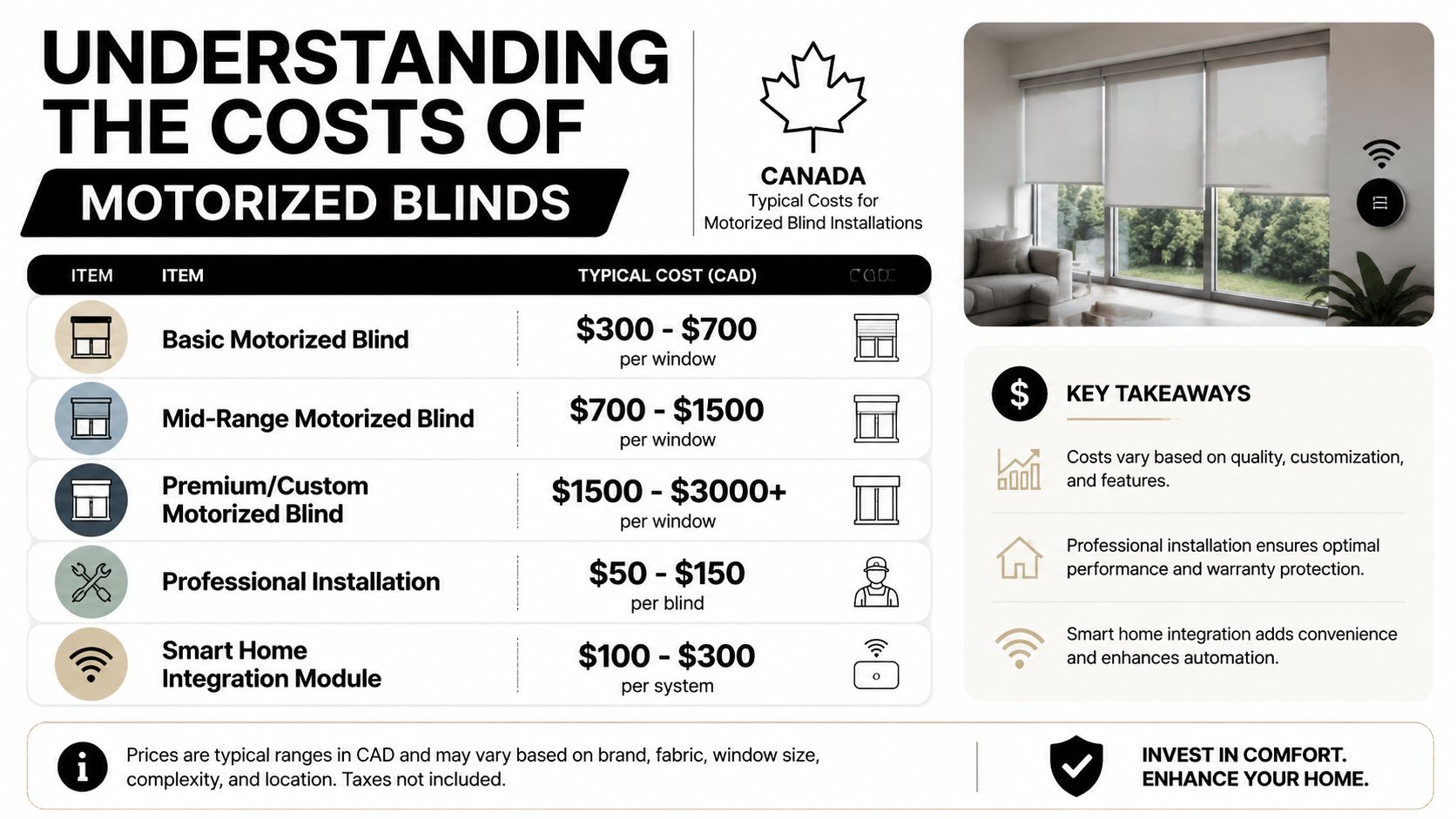
Motorized blinds usually sit in the premium category, but the price makes more sense once you break it into parts. You are paying for the window covering itself, the motor that lifts or lowers it, the control method, and sometimes extra setup if you want grouped operation or smart-home features.
What the Canadian price range usually includes
In Canada, motorized blinds are commonly priced at about CAD $300 to $1,000 per window, depending on size, fabric, and control features, based on Canada-focused motorized blind pricing from Go Smart Blinds.
A simple way to read that range is to treat it like building a small system, not buying a single object. The fabric affects the look and light control. The motor affects performance and power method. The controls affect how convenient the blind is to use every day.
That is why two homes can both ask for "motorized blinds" and receive very different quotes.
This video gives a useful look at motorized blind systems in action.
What changes the quote
Window size is one of the biggest cost drivers. A large patio door shade asks more from the material and often from the motor too. A small bedroom window usually needs less of both.
Fabric choice matters for the same reason winter coats vary in price. Some materials do more. Blackout fabrics, designer textures, and specialty weaves can raise the quote compared with a basic light-filtering option.
Control style changes the total as well. A handheld remote is often the simplest starting point. Adding wall switches, app control, or a hub adds hardware and setup time. If you want several blinds grouped to move together, that also affects programming and overall system design.
The window itself can also create extra labour. Deep frames, shallow trim, unusual shapes, or hard-to-reach locations take more planning than a standard opening. In older Canadian homes, installers sometimes need to work around uneven frames or limited mounting depth.
A multi-room project usually costs more upfront, but the price per blind can look different than a one-window order because measuring, programming, and installation are being done as one job.
Higher pricing often reflects better fit, stronger motor planning, and cleaner control setup, not just a fancier fabric.
How to budget without guessing
A good budget starts with the rooms you use most. Many families begin with one or two problem windows, such as a bright west-facing living room or a nursery where cordless operation matters most.
Then compare choices in layers:
- basic motorized control
- upgraded fabric or blackout material
- grouped controls for multiple windows
- app or hub-based automation
That approach keeps the decision clear. You can see which cost is tied to comfort, which cost is tied to convenience, and which cost is optional for now.
If you want a clearer picture of what affects pricing in a real home, this motorized blinds cost and options guide can help you compare features before requesting a quote.
Buying from a local Canadian installer also has value that is easy to miss on a price sheet. Accurate measuring, product support, battery or motor servicing, and help with replacement parts all matter more after the sale than they do on day one. In a Canadian climate, where blinds often help with summer heat gain and winter privacy, long-term performance is part of the overall cost too.
Installation Process and Long-Term Maintenance
A well-planned install feels quiet and boring, and that's a good thing. Good motorized blind jobs don't need drama. The measurements are right, the brackets land where they should, the shade runs smoothly, and the controls are programmed before the installer leaves.
That matters even more with motorized products because small errors show up fast. If a bracket sits slightly off or the dimensions are too tight, the blind may look uneven or operate poorly.
What installation day looks like
Professional installation usually follows a predictable sequence.
First comes final measuring. The installer then confirms width, drop, mounting surface, trim clearance, and whether the blind should sit inside or outside the frame.
Then the hardware goes up. Brackets are mounted, the blind is fitted, and the motor is paired with the selected control method.
Last comes testing and programming. The installer checks travel limits, alignment, response speed, and whether grouped blinds move properly together.
A clean install also includes the small details people notice later:
- Level mounting: Crooked blinds look worse once they move.
- Neat wiring decisions: Important for any powered or charging setup.
- Control pairing: Remotes, wall controls, and apps should be labelled clearly.
- User handoff: Everyone should know how to operate and reset the system.
If you're comparing service options, this installation information page is the kind of resource worth reviewing because it shows what a more complete install process can include beyond merely hanging the blind.
Keeping them running smoothly
Motorized blinds are usually low-maintenance, but low-maintenance doesn't mean no maintenance. A little routine care helps them stay quiet, aligned, and easy to use.
Start with dusting. A soft cloth, light vacuum brush, or manufacturer-approved cleaning method is usually enough for most fabrics and vanes.
For battery-powered models, the main habit is staying ahead of charging or battery replacement. Don't wait until the blind stops halfway. If operation sounds strained or becomes inconsistent, that's the time to check the power source.
A few ownership habits help:
- Keep the window area clear: Furniture and decor can block full travel.
- Don't force the blind by hand: Let the motor do the movement it was designed for.
- Use the proper charger or battery type: Mixing components can create avoidable problems.
- Call for service when alignment changes: Small issues are easier to correct early.
If a shade starts moving unevenly, don't keep testing it all week. A quick service call usually prevents a bigger adjustment later.
Canadian homes also bring seasonal quirks. Winter dryness, condensation near glass, and extra dust around forced-air heating can affect how window coverings age. That's another reason precise fit and the right product selection matter from the start.
Why Choose a Canadian Installer Like Blinds Hut
Where you buy motorized blinds matters almost as much as which blind you buy. The product can be solid, but if the measurements are loose, the motor choice is wrong, or the controls aren't set up around your routine, the whole job feels disappointing.
That's why local installers often bring real value. They're usually solving for actual homes in your area, not just shipping a box with generic instructions.
Why local service changes the experience
A Canadian installer sees the practical stuff up close. Deep window frames in one neighbourhood, older trim in another, condo rules in one building, family rooms with oversized patio doors in another.
That local context helps with decisions like inside mount versus outside mount, battery versus hardwired, and which fabric works better for glare, privacy, or room darkening. Those aren't abstract design choices. They affect how happy you are with the blinds six months later.
Blinds Hut is one example of that local model. Based on the publisher information provided, it offers custom blinds and shades in London, Ontario, including motorized and smart options, along with in-home consultation, measurement, and installation support.

What to look for before you book
Whether you choose a family-run company or another local provider, a few things are worth checking before you commit.
- Measured-to-fit products: Custom sizing matters more with motorization than with basic off-the-shelf blinds.
- Installer involvement: The person advising you should understand both product and mounting conditions.
- Clear control options: You should know whether you're getting remote, wall, app, or voice-ready operation.
- After-install support: Pairing, resets, and adjustments are part of ownership.
- Canadian suitability: Ask how the product fits your window type, room use, and home style.
A good buying experience should feel straightforward. You ask questions, someone gives plain answers, the quote matches the plan, and the finished blind works the way it was described.
That's especially important with motorized blinds in Canada, where climate, retrofit constraints, and family safety often matter more than flashy smart-home language.
If you want help choosing a practical setup for your home, Blinds Hut offers custom window covering support in London, Ontario, with in-home consultation, measuring, and installation for motorized options.