Custom Window Treatment a Complete Buyer’s Guide for 2026
You're probably staring at a window that never looks quite right. The blind is a bit too narrow, light leaks in at the sides, the colour looked better online, and the whole thing feels like a compromise.
That's where a custom window treatment earns its keep. It isn't just about making a window look nicer. It's about getting the fit, function, insulation, privacy, and daily usability right the first time, especially in Ontario homes where winter comfort and summer sun both matter.
Table of Contents
- What Are Custom Window Treatments Anyway
- Choosing Your Style Blinds Shades and Shutters
- The Power of Automation Smart and Motorized Options
- The Perfect Fit Measurement and Installation Process
- Understanding Cost and Value Factors
- Why a Local Expert Like Blinds Hut Matters
- Your Custom Window Treatment Questions Answered
What Are Custom Window Treatments Anyway
A custom window treatment is the difference between “good enough” and “fits like it belongs there.” Store-bought blinds come in preset sizes. Custom treatments are made for your exact opening, your light needs, and how you use the room.
Think custom suit versus off-the-rack. One might work. The other is built around you.
A lot of homeowners mix up three different things:
- Ready-made treatments are mass-produced in standard widths and lengths.
- Cut-to-size options start with a standard product and get trimmed down.
- True custom treatments are measured, ordered, built, and installed for your specific window.
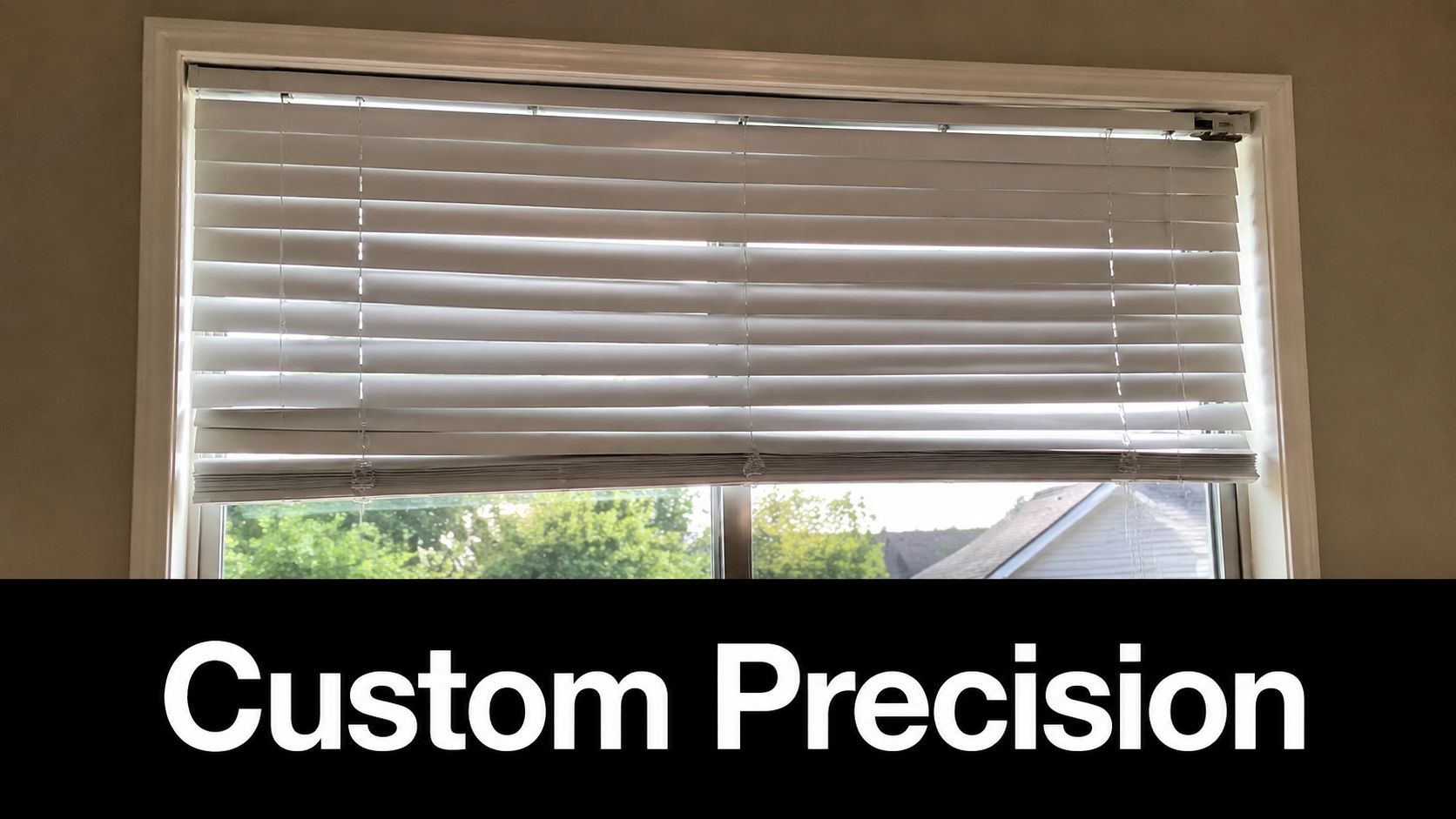
That last option matters more than people realise. A proper custom window treatment can sit tighter in the frame, operate more smoothly, and look cleaner because the proportions were planned from the start.
There's also a bigger market reason this category keeps growing. The global window covering market was valued at USD 15.07 billion in 2025, with North America holding 37.46% of the market, according to Fortune Business Insights on the window covering market. That tells you custom coverings aren't some niche design indulgence. They're a normal part of how people upgrade homes.
Practical rule: If the window is prominent, oddly shaped, drafty, or hard to reach, skip the compromise and go custom.
Custom also means better decision-making before anything is built. You choose mount type, control style, opacity, fabric or slat material, cassette or valance options, and how the treatment will work with trim, furniture, and traffic flow.
If you're weighing the difference between made-to-measure and retail options, this guide on custom window coverings over store-bought blinds in London, Ontario is worth a look.
Choosing Your Style Blinds Shades and Shutters
Don't start with colour. Start with the job the window needs to do.
Do you need tighter privacy in a bathroom, softer light in a living room, blackout in a bedroom, or extra insulation on a cold exterior wall? Once you answer that, the style choice gets easier.
Blinds
Blinds are the best choice when you want adjustable light control. You can tilt the slats, redirect daylight, and still keep some privacy.
That slat detail isn't minor. Commercial and institutional specifications often call for horizontal blinds with 25 mm or 50 mm slats and a tilt mechanism capable of 180° rotation, as noted in the UFGS specification for horizontal blinds. In plain language, slat size changes how the blind looks and performs.
Here's the practical version:
- 25 mm slats suit tighter visual lines and finer light adjustment.
- 50 mm slats feel bolder, show less visual clutter, and often suit larger windows better.
- Faux wood blinds handle moisture better than real wood in kitchens and baths.
- Aluminium blinds work when you want a slimmer, more utilitarian profile.
Blinds are a strong pick if you like control and don't mind seeing the slat structure.
Shades
Shades are cleaner and softer. Instead of slats, they use fabric or layered material that lifts or rolls.
If insulation matters, shades often win. In colder climates, guidance commonly recommends honeycomb blinds, acrylic roller blinds, or lined blackout curtains because their layered construction helps reduce heat loss at the glass surface. That matters in Ontario, where comfort near the window can change a room.
Common shade options include:
- Roller shades for a simple, modern look
- Zebra shades if you want alternating bands for flexible privacy and light
- Cellular shades when energy performance is high on your list
- Blackout shades for bedrooms, media rooms, and nurseries
For bedrooms and street-facing rooms, I usually tell people to choose function first and fabric second. Privacy mistakes get annoying fast.
Shades also tend to suit homes where you want less visual busyness. They disappear more easily into the room.
Shutters
Shutters are the most architectural option. They feel built-in because, in a sense, they are.
They work well when you want strong curb appeal inside the room, a crisp frame around the window, and a durable finish that doesn't read as temporary. They're especially effective in living rooms, dining rooms, and homes with trim details worth matching.
The trade-off is simple. Shutters are usually a more committed design choice. They won't melt into the background like a roller shade, and that's exactly why some homeowners love them.
Window Treatment Types at a Glance
| Type | Best For | Light Control | Material Options |
|---|---|---|---|
| Blinds | Adjustable daylight and privacy | High, with slat tilt | Faux wood, wood, aluminium |
| Shades | Soft look, insulation, blackout options | Moderate to high, depending on fabric | Fabric, layered textiles, cellular materials |
| Shutters | Built-in appearance and durability | High, with louvre adjustment | Wood, composite, faux wood |
If you're stuck between two options, use this shortcut:
- Pick blinds if you want the most active control over light angle.
- Pick shades if you care most about softness, insulation, or blackout.
- Pick shutters if you want a permanent, customized architectural look.
The Power of Automation Smart and Motorized Options
Motorization isn't just a luxury add-on anymore. In the right room, it solves real problems.
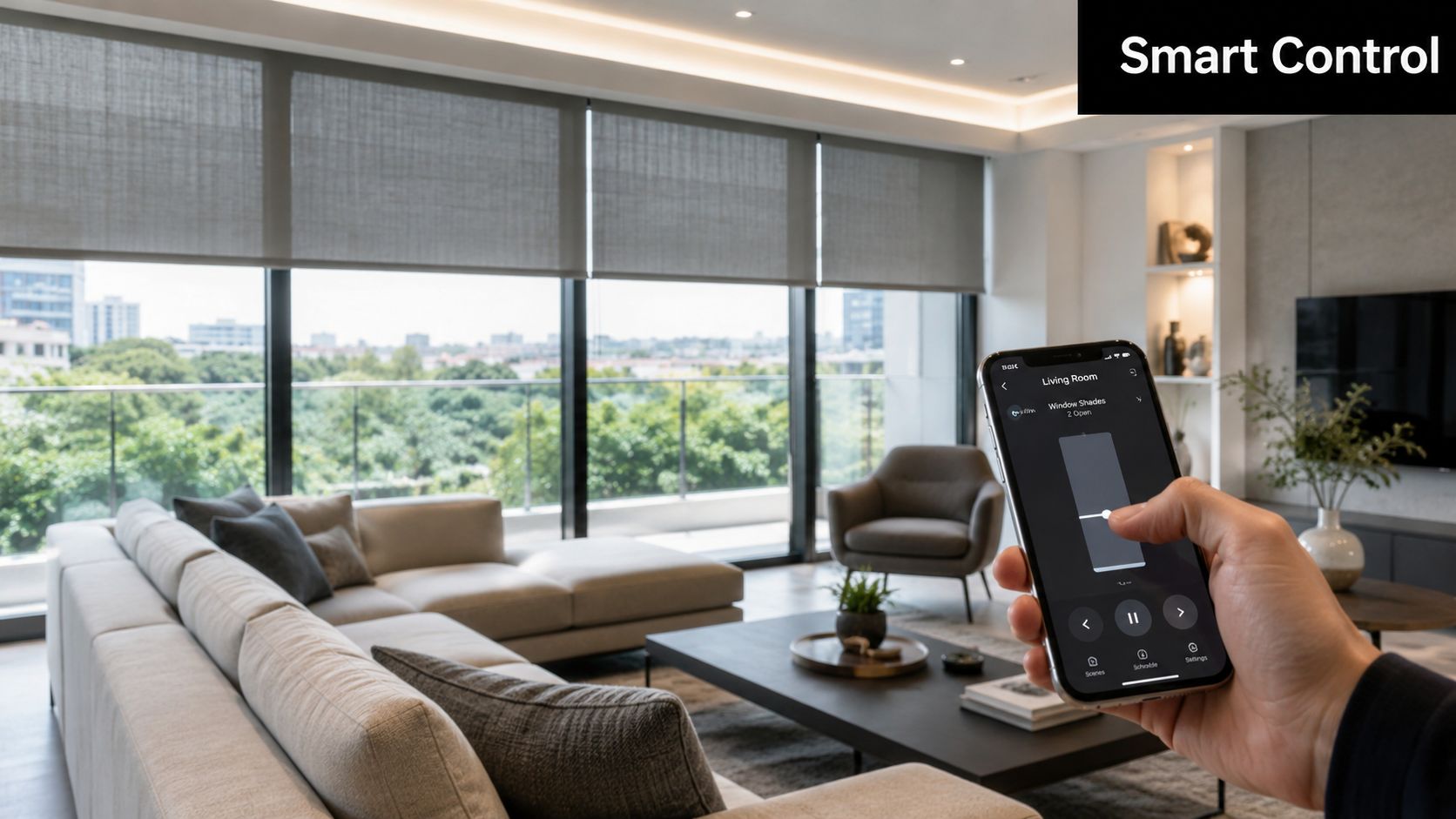
If you've got a tall foyer window, a bay window behind furniture, or a bright west-facing room that overheats every afternoon, manual operation gets old fast. A motorized custom window treatment gives you consistent control without cords, stretching, or climbing.
Why motorization makes sense
Value goes beyond convenience. As explained in Hunter Douglas guidance on specialty shapes and motorized use cases, homeowners often choose motorized options for energy management, improved accessibility for aging-in-place, and control of large or hard-to-reach windows.
That lines up with what I see in actual homes. Motorization makes the most sense when the window is awkward, the sunlight is aggressive, or the homeowner wants reliable routines instead of daily fiddling.
A few rooms where I'd recommend it without much debate:
- Primary bedrooms with blackout shades
- Great rooms with tall banks of windows
- South or west-facing spaces where solar gain builds through the day
- Stairwells and above-tub windows that are annoying to reach
- Homes with kids or pets where cord-free operation matters
If you want a practical overview of available systems, this page on motorization for blinds lays out the main options.
You can see the concept in action here:
Battery or hardwired
Battery-powered systems are usually the easier retrofit. They work well when you don't want electrical work opened up after the room is finished.
Hardwired systems make more sense during a renovation or new build, especially when you're planning multiple windows together. They keep power hidden and reduce the need to think about recharging or battery replacement.
Motorization pays off fastest on windows you use often, windows you avoid using, and windows you can't reach safely.
My take is simple. Don't motorize every window just because you can. Start with the problem windows first. That's where the upgrade feels smart, not flashy.
The Perfect Fit Measurement and Installation Process
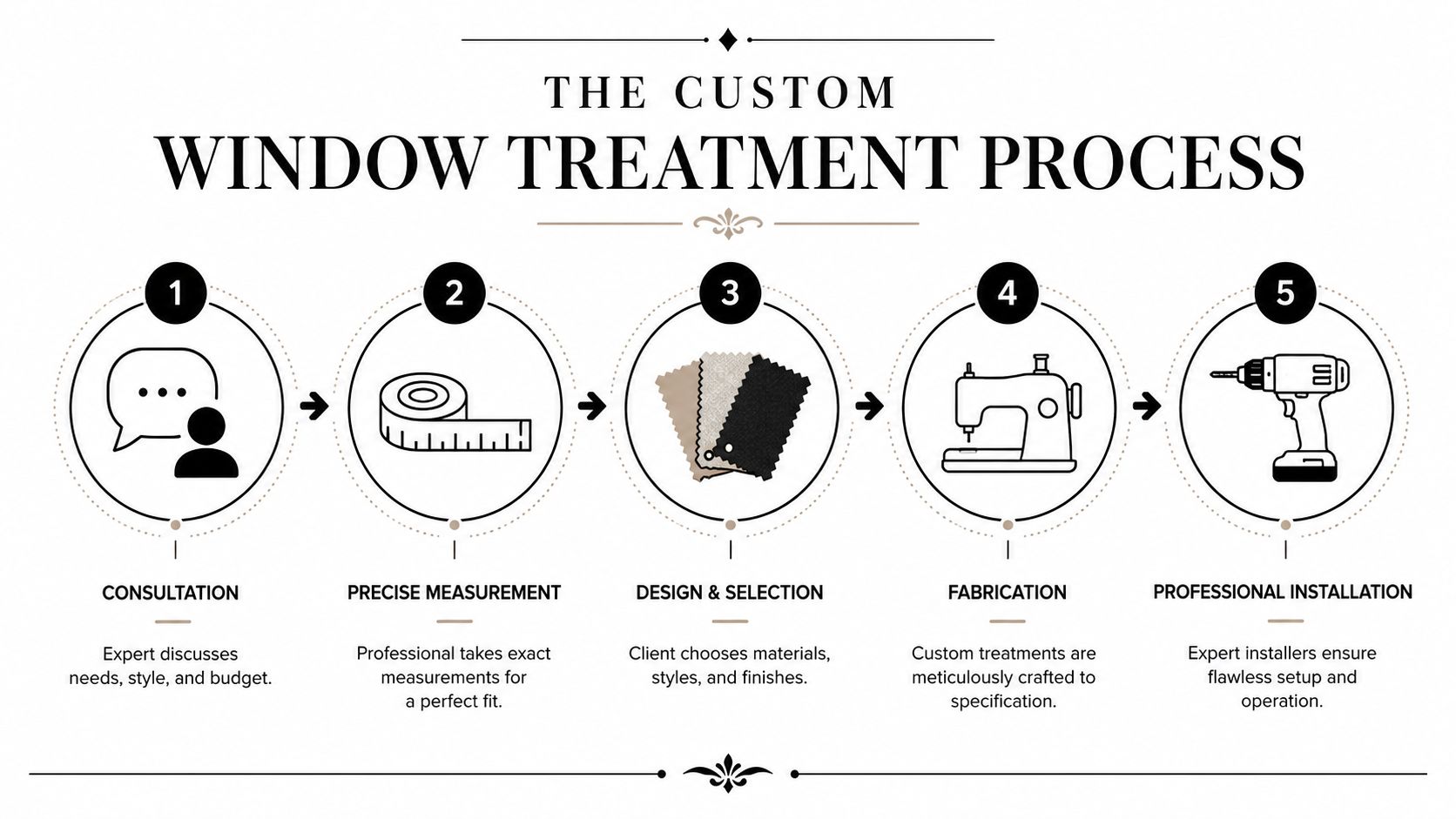
The biggest mistake buyers make is treating measurement like a minor detail. It isn't. The measurement and installation process is where a custom window treatment either proves its value or falls apart.
What happens at the consultation
A good consultation happens in your home, with real samples in your actual light. That part matters because white fabric can look warm in one room and stark in another.
The installer or consultant should check more than width and height. They should look at window depth, trim clearance, crank handles, door swings, furniture placement, and whether an inside or outside mount makes more sense.
A clean process usually looks like this:
- Discuss the room's job. Privacy, glare control, blackout, insulation, or appearance.
- Review product options. Not every style suits every opening.
- Take exact measurements. Exact measurements differentiate custom work from guesswork.
- Confirm controls and finish details. Manual, cordless, motorized, fabric opacity, cassette style.
- Install and test. The treatment should operate smoothly and sit square.
Where custom work matters most
Specialty windows are where professional measurement stops being helpful and becomes necessary. Guidance for irregular openings notes that bay windows and other unusual openings almost always require custom-made treatments with professional measurement, and that motorized blinds are often the most practical solution for access and reduced wear, as covered in this video guidance on window coverings for challenging windows.
That includes spaces like:
- Bay windows with multiple angles
- Arched or angled windows
- Deep-set frames
- Patio doors
- Windows behind sinks or tubs
If you want to understand the install side better, this page on how to install custom blinds shows why pros pay attention to details homeowners often miss.
A window can be perfectly square on paper and still install badly if the frame is out, the trim is uneven, or the hardware placement wasn't planned.
Good installation should also include final adjustment, clean-up, and a quick walk-through so you know how to operate and maintain everything properly.
Understanding Cost and Value Factors
Price matters, but custom window treatments are not a commodity purchase. You are paying for fit, function, and how the treatment performs in your home over time, especially through Ontario winters and bright summer afternoons.
A cheap blind that leaves light gaps, loses heat at the glass, or starts failing after a year is not good value.
What changes the price
Cost usually comes down to five things:
- Window size. Larger windows need more material and stronger hardware.
- Product type. Shutters, dual shades, Roman shades, and roller shades are built differently and priced differently.
- Material. Real wood, composite, woven fabrics, and performance materials do not cost the same, and they do not wear the same.
- Controls. Manual, cordless, and motorized options each add a different level of hardware and setup.
- Installation conditions. Tall windows, tricky access, and unusual shapes increase labor and planning time.
The part many homeowners miss is this: custom pricing includes service, not just the product. A local specialist helps you avoid the expensive mistakes that show up after install, like the wrong opacity in a bedroom, a shade stack that blocks too much glass, or a treatment that looks good in a sample book but feels cold and impractical in a drafty room.
What adds real value
Spend more where the upgrade solves a daily problem.
I recommend focusing on these:
- A tighter, cleaner fit that looks better and blocks more light
- Insulating options for older windows, large glass areas, and cold-facing rooms
- Motorization for tall, wide, or frequently used windows
- Moisture-resistant or easy-clean materials in kitchens, bathrooms, and busy family spaces
In Ontario, energy performance deserves more attention than it gets in generic buying guides. Cellular shades, lined Romans, and well-fitted layered treatments can make chilly rooms feel more comfortable and reduce how hard your furnace works near the window wall. That benefit shows up every day, not just on the invoice.
Good value is simple. Choose the treatment that fixes the room, suits the climate, and keeps working without constant frustration.
Why a Local Expert Like Blinds Hut Matters
You order a shade online, measure once, and hope for the best. Then it arrives a little too narrow, leaks light at the sides, and looks off against the trim. That is the point where custom stops being about the product and starts being about the people handling the job.

A local specialist gives you one accountable team from first visit to final adjustment. That matters more than homeowners expect. The right treatment on paper can still fail in the room if the sample was viewed under the wrong light, the headrail clearance was missed, or the installer did not plan around old trim, deep sills, or slightly out-of-square openings.
Specialty dealers continue to win custom projects for a reason. Buyers want advice, accurate measuring, proper installation, and someone local to call if a bracket shifts or a motor needs programming. In Ontario, they also need guidance that generic online guides usually skip, like which options help in a cold bedroom, a drafty bay window, or a living room with a big west-facing glass wall.
Here's what I recommend looking for in a local company:
- An in-home consultation with samples held up in your actual light
- Advice tied to the room so the recommendation fits privacy, glare, insulation, and daily use
- Accurate measuring and installation done by the same company that sold the treatment
- After-install support for adjustments, programming, and small fixes
Blinds Hut is one local option in London, Ontario that offers custom blinds, shades, shutters, motorized products, in-home consultations, and certified installation.
The product matters. The person measuring it matters more.
That is especially true in older Ontario homes, where windows often look standard from across the room and turn out not to be standard at all. A good local pro catches those details before your order is placed, which is exactly how you avoid wasted money, repeated appointments, and a treatment that never feels quite right.
Your Custom Window Treatment Questions Answered
How long does the process usually take
It depends on the product, fabric, and whether motorization is involved. Custom orders take longer than buying something off the shelf because the treatment is being made for your window, not pulled from a warehouse.
Are custom treatments worth it for one room only
Yes. Start where the pain point is worst. Usually that's the bedroom, living room, patio door, or a cold room with large windows.
What's easiest to clean
Roller shades and shutters are usually simple to maintain. Blinds need more frequent dusting because of the slats. Fabric shades should be cleaned gently and according to the manufacturer's care guidance.
Do I need motorization everywhere
No. Put it on the windows that are hard to reach, used every day, or exposed to strong sun at the same time each day.
What works best for odd-shaped windows
Custom-measured solutions. Specialty shapes are where DIY shortcuts usually fail, either visually or mechanically.
What should I bring to a consultation
Bring photos you like, note which rooms get harsh sun, and decide what matters most: privacy, blackout, insulation, style, or convenience. That helps narrow choices fast.
If you want help choosing the right custom window treatment for your home, contact Blinds Hut. A local consultation can save you from the usual mistakes, especially if you're dealing with tricky windows, cold rooms, or you want motorized options that fit the way you live.