
Commercial Window Blinds: Expert Guide for 2026
You're probably looking at a space that feels harder to manage than it should. The west-facing offices get blasted in the afternoon, staff keep shifting desks to avoid screen glare, the front windows look dated, and every quote you've seen so far focuses on the purchase price instead of what the system will cost you over time.
That's the wrong way to buy commercial window blinds. In a business setting, the better question is what the blinds do for comfort, upkeep, appearance, and day-to-day operation after installation.
Table of Contents
- Why Your Business Needs the Right Window Blinds
- Decoding the Options Types of Commercial Blinds
- Performance Beyond Privacy Key Characteristics
- Smart Operations Motorization and Controls
- Built to Last Compliance and Durability
- Choosing the Right Blinds for Your Space
- The Blinds Hut Advantage From Measurement to Installation
Why Your Business Needs the Right Window Blinds
A lot of owners treat window coverings like a finishing touch. In commercial work, that's rarely how they function. They affect comfort, privacy, visual consistency, cleaning routines, and how the space performs during a normal workday.
Commercial window blinds also sit inside a real procurement chain, not just a décor purchase. In Canada, the Blind and Shade Manufacturing industry under NAICS 337920 is tied to contract outfitting and installation for office retrofits, institutional fit-outs, and multi-unit properties, not just consumer home improvement, as outlined in industry context for blind and shade manufacturing.
That matters because the buying decision usually involves more than one person. The office manager cares about glare, the property manager cares about lifespan, the designer cares about appearance, and the contractor cares about fit and install sequencing.
A bad blind choice gets expensive fast
The cheapest option on paper often creates extra cost later:
- More staff complaints: Poor glare control turns sunny windows into a daily problem.
- More maintenance calls: Light-duty hardware doesn't hold up in busy spaces.
- More visual inconsistency: Off-the-shelf products often look uneven across large elevations.
- More replacement risk: A system that fits badly or wears quickly gets replaced long before it should.
Practical rule: Buy for the window's job, not just the room's style.
If the glass faces strong sun, that window covering is part of your daylight and heat-control strategy. If it's in a lobby, it also shapes first impressions. If it's in a clinic, school, or office, it has to function reliably without becoming one more facility issue on the list.
The right commercial window blinds don't just block sunlight. They support how the space works, how it feels, and how long your budget lasts.
Decoding the Options Types of Commercial Blinds
Most buyers get shown a product board before anyone talks about exposure, window size, or how often the blinds will be used. That's backwards. The product category only makes sense once you know what the window has to do.
Start with the window, not the catalogue
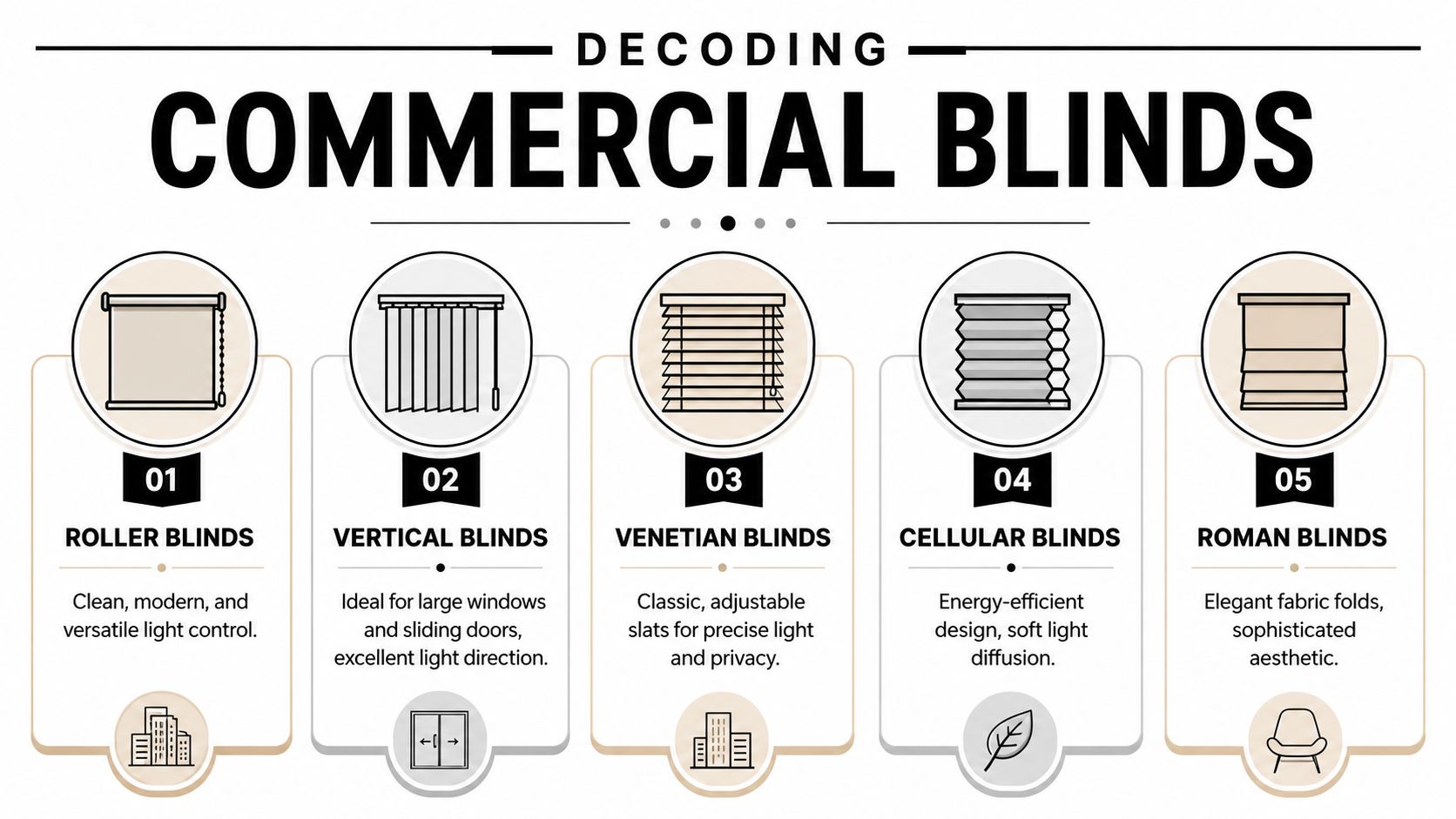
Roller shades are often the cleanest answer for commercial spaces with large glazing. They look organised, take up little visual space, and can be specified around glare, privacy, and openness. For high-performance applications, commercial roller shades are commonly used because fabric openness and motorized operation directly manage solar gain and glare, and for large windows, motorized systems improve reliability and reduce wear compared with manual controls, especially in south- and west-facing offices, as shown in Lutron's commercial shades guidance.
Vertical blinds still have a place, especially on wide openings and sliding-style expanses. They're practical, easy to understand, and useful where you need broad light direction control without a more technical shade system.
Venetian blinds give precise slat adjustment. Aluminum versions fit busy workspaces better than more delicate materials because they're easier to wipe down and better suited to repeated use.
Zebra blinds suit commercial interiors that want a softer, more designed look. They can work well in client-facing spaces, but they're usually a better fit for lighter-duty areas than for heavy-use settings with frequent adjustment.
Solar and UV-control fabrics are often the better answer when the primary issue is glare on screens, not total blackout. In offices with views, they let you keep daylight and outward visibility while softening the harshness that causes complaints.
Some projects also benefit from panel systems instead of standard blinds, especially on broader glazed areas. If you're comparing formats for large openings, this guide to panel track window blinds for wide window coverage is worth reviewing.
Commercial Blind Types at a Glance
| Blind Type | Best For | Light Control | Durability | Maintenance |
|---|---|---|---|---|
| Roller shades | Offices, boardrooms, large glazed elevations | Very good, depends on fabric | Strong when properly specified | Low |
| Vertical blinds | Wide windows, sliding-style openings | Good directional control | Good in practical settings | Moderate |
| Venetian blinds | Private offices, classrooms, admin spaces | Precise slat control | Good, especially aluminum | Moderate |
| Cellular blinds | Spaces where insulation matters | Soft, even light control | Moderate | Low to moderate |
| Roman blinds | Hospitality or executive settings | Good, fabric dependent | Better in lighter-duty spaces | Moderate to high |
| Zebra blinds | Showrooms, reception, styled interiors | Flexible filtered privacy | Moderate | Moderate |
If your windows are large and the blinds will move often, hardware quality matters more than fabric colour.
What usually works best is matching product type to operational reality. A reception area can justify a more polished finish. A tenant office with strong afternoon sun usually benefits more from a roller or solar shade system that manages glare consistently and doesn't ask too much from the user.
Performance Beyond Privacy Key Characteristics
Privacy is only one part of the job. In commercial settings, the better question is how a window treatment changes the room during working hours.
That's where total cost of ownership becomes useful. A product that costs less upfront but leaves you with heat buildup, uneven daylight, and repeated manual adjustment can be the more expensive choice over its life.
What affects return over time
Modern commercial shades are often chosen for heat and glare reduction, not merely because glass needs covering. Guidance for commercial applications highlights reducing heat and glare to improve energy efficiency, and it points buyers toward a decision framework based on solar control and automation when they need to manage operational costs, as noted in commercial window shade performance guidance.
In practical terms, four performance factors drive value:
- Glare control: Staff can work more comfortably when screens aren't fighting direct sun.
- Thermal moderation: Perimeter rooms feel less extreme through the day.
- Consistency: Matching fabric and hardware across multiple openings makes the space easier to manage.
- Operational simplicity: The easier the system is to use, the more likely people are to use it properly.
A boardroom is a good example. If one side of the room gets hard afternoon light, people close whatever covering is there, regardless of whether it was meant for that condition. If the system handles glare without making the room gloomy, the room works better and the product gets used as intended.
Where cheap products usually cost more
Low-price commercial window blinds often fail in routine ways, not dramatic ones. The clutch gets rough. The bottom bars stop lining up. One fabric panel rolls tighter than the next. After that, the blinds still exist, but the room never looks finished.
Here's where owners usually feel the difference between price and value:
| Performance area | Low-cost outcome | Better-specified outcome |
|---|---|---|
| Daylight control | Uneven glare from one opening to another | More consistent comfort across the room |
| Operation | Frequent manual correction | Smoother use, less daily fuss |
| Appearance | Misaligned hems and mixed sightlines | Cleaner elevation from inside and out |
| Upkeep | More service calls and spot fixes | Fewer interruptions over time |
Better commercial window blinds should solve a room problem every day without anyone thinking about them.
Acoustics can matter too, especially in open-plan interiors. Fabric-based systems can help soften the harder feel of a glass-heavy room. I wouldn't choose a blind solely for sound control, but in echo-prone spaces it can be a useful secondary benefit.
Smart Operations Motorization and Controls
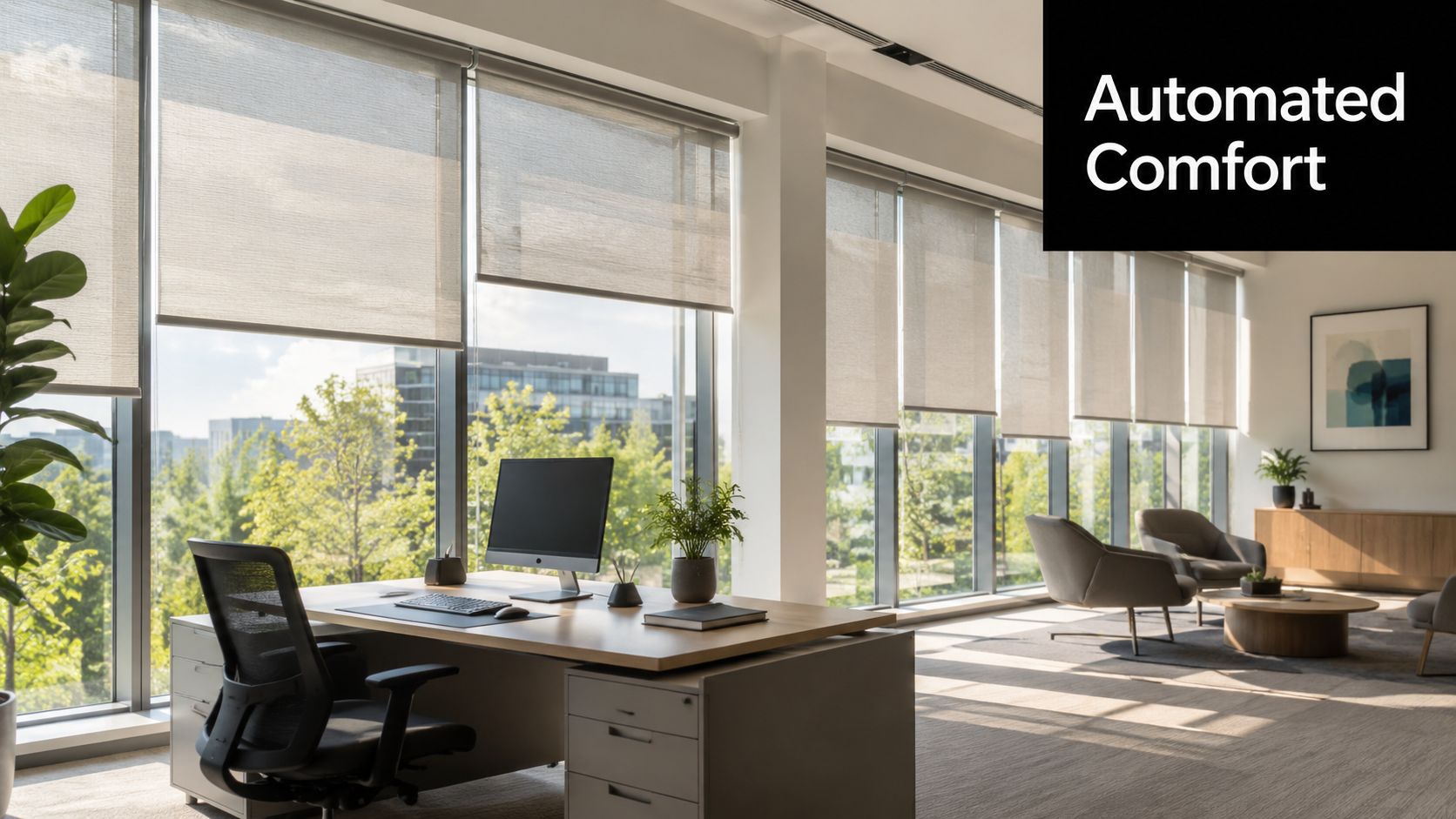
Motorization stops being a luxury once the windows are tall, the sun pattern is predictable, or the staff are tired of adjusting the same shades every afternoon. It also cleans up the look of a space. No hanging cords, fewer uneven positions, and a more uniform façade from the exterior.
When motorization earns its keep
Motorized systems make the most sense when a manual blind creates friction. That could mean tall glazing in a lobby, a row of west-facing offices, or a meeting room where no one wants to stop and adjust six windows before a presentation.
They also improve consistency. One of the biggest differences between manual and automated systems isn't the movement itself. It's that automated shades tend to end up in the same position every time, which keeps light levels and appearance more controlled.
If you're considering an upgrade path, this page on motorized blinds in Canada for homes and businesses gives a helpful overview of common system options.
Control options that make sense
Not every project needs app control or full building integration. The right setup depends on who uses the room and how often conditions change.
- Wall switches: Best for conference rooms, reception areas, and shared spaces where simple control matters.
- Handheld remotes: Useful when flexibility matters more than fixed controls.
- Scheduled automation: Good for spaces with predictable sun exposure through the day.
- Integrated controls: Best when the blinds need to work alongside a broader building system.
A simple rule helps here. If people will forget to adjust the shades, automate them. If someone is already managing the room and can make quick changes, manual or basic powered control may be enough.
Here's a quick visual look at how automated commercial shades operate in a modern setting.
Motorization also changes the brand feel of a space. Clients notice when a room responds smoothly to light and privacy needs. Staff notice when the space feels maintained instead of improvised.
Built to Last Compliance and Durability
Commercial blinds get used harder than generally expected. Staff pull them quickly, cleaners work around them, tenants misuse them, and sunlight tests every material choice over time. If the system is light-duty, the wear shows up early.
That's why durability and compliance belong in the same conversation. A blind that looks good on day one but creates accessibility or service issues later isn't good value.
Compliance needs to be designed in early
For commercial projects, accessibility affects how the product is specified, not just how it's installed. ADA-aligned guidance often places blind controls between 15 and 48 inches above the floor, and motorization can simplify compliance by removing the need for manual cord or wand operation, as explained in commercial blinds accessibility guidance.
That requirement sounds simple until the room is built. Window height, sill depth, furniture placement, and hardware geometry all affect whether a manual control lands where it should.
A few habits prevent expensive rework:
- Document control locations early: Don't leave this to the installer on site.
- Check reach from finished floor level: Drawings don't always reflect real conditions.
- Coordinate with furniture plans: A compliant control isn't useful if a cabinet blocks it.
- Use motorization where reach is awkward: It solves a lot of access problems cleanly.
Noncompliant controls rarely look like a big issue during quoting. They become a big issue at handover.
Durability is a budget decision
Durability starts with matching hardware to use. A private office where the blind moves occasionally can carry a different system than a classroom, clinic, or shared workspace where the treatment gets handled all day.
The smartest durability choices are usually boring ones:
| Component | What lasts better in commercial use |
|---|---|
| Hardware | Commercial-grade mechanisms sized for the opening |
| Material | Finishes that handle cleaning and sunlight without showing wear fast |
| Operation | Motorized systems on large or frequently used windows |
| Installation | Secure brackets, level alignment, and proper field measurement |
Maintenance is part of TCO as well. Dusting, occasional wipe-downs, and prompt service for misalignment keep small issues from becoming replacements. Once users start tugging harder because a blind tracks poorly, the system tends to deteriorate quickly.
Choosing the Right Blinds for Your Space
The best product changes with the room. A law office, coffee shop, clinic, and rental building can all need different answers even when the windows are similar.
That's why I prefer room-by-room decisions over one product pushed through the whole project. Consistency matters, but function comes first.

Office and professional spaces
A typical office problem starts with screen glare and temperature swings near the perimeter. In that setting, solar or roller shade systems usually make more sense than decorative blinds with lots of slats and more cleaning points.
For open offices, a filtered roller shade often gives the best balance. It softens direct light, keeps the elevation neat, and avoids the visual clutter that comes from many horizontal slats across many windows.
For boardrooms, think about use patterns. If presentations happen regularly, blackout or lower-openness fabrics are often more useful than a product chosen only for appearance.
For reception and client-facing offices, the treatment should support the brand without becoming fussy. A clean roller shade, a refined zebra blind, or another custom window treatment designed for the room's exact light and privacy needs usually looks more intentional than a generic ready-made product.
Retail hospitality and multi-unit properties
Retail has a different pressure. You want glare control and some UV protection, but you also want the storefront or merchandising to remain inviting. Heavy blackout treatments often feel too closed during business hours unless they're for stockrooms or after-hours privacy.
Hospitality spaces usually need layered thinking. The front-of-house windows may need appearance and daytime control, while guest rooms or private suites often need stronger privacy and better light blocking for comfort.
Multi-unit and rental properties call for durability and straightforward service. Property managers usually benefit from products that are simple to operate, easy to clean, and consistent to replace if one unit needs a repair.
Here's a practical way to match space to product:
- Modern office: Roller or solar shades for glare management and a clean façade.
- Retail store: Light-filtering systems that protect comfort without shutting down visibility.
- Hospitality setting: Softer, more polished treatments in public areas and stronger room-darkening where guests need rest.
- Multi-unit property: Durable, repeatable products with sensible maintenance demands.
The right choice is the one your staff, tenants, or guests can live with every day without fighting it.
The Blinds Hut Advantage From Measurement to Installation
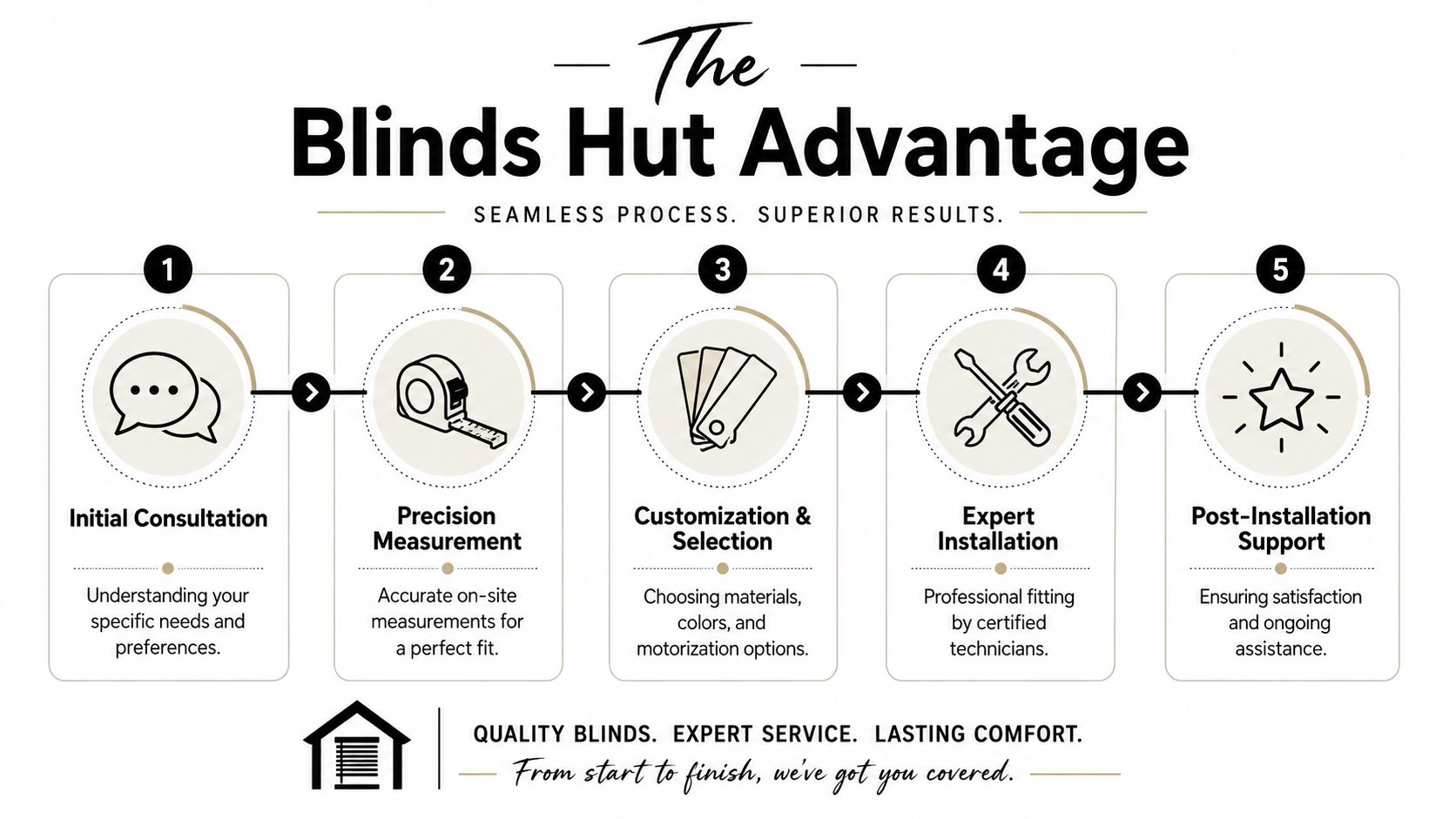
The hardest part of a commercial blind project usually isn't choosing a colour. It's getting the measurements, fabrication, hardware, and installation details right so the finished job performs the way it should.
That matters even more on unusual openings. Guidance for angled, irregular, and atrium-style windows notes that these applications often require custom-made treatments, accurate multi-point measurements, and specialized mounting to avoid light gaps and fit issues, which is why expert handling for angled window blinds and shades is so important.
What a professional process should include
A proper commercial process should cover more than a quote sheet:
- Site review: Measure real conditions, not just plan dimensions.
- Product matching: Select hardware and fabric for use frequency, glare, privacy, and cleaning needs.
- Control planning: Resolve manual reach, motorization, and layout details before fabrication.
- Installation quality: Level brackets, aligned hems, clean finishes, and tested operation.
- Aftercare: A clear path for adjustments, service, and future phases.
Blinds Hut handles that process end to end with custom Canadian-made products, free in-home or on-site consultations, precision measurement, certified installation, factory-direct value, and a 10-year warranty on cassettes. For business owners, contractors, and property managers, that kind of coordinated delivery usually saves more trouble than chasing the lowest line item.
If you're weighing options for Blinds Hut, the best next step is a proper on-site consultation. You'll get product guidance based on the way your windows perform, not a generic catalogue pick, plus precise measurements, fabric and control recommendations, and a clear installation plan that fits your space and budget.