Roller Shades for Sliding Glass Doors: The Complete Guide
A lot of homeowners end up staring at the same problem. The sliding glass door brings in the best light in the house, but it also brings glare, nighttime exposure, and that awkward feeling that everyone outside can see straight in once the sun goes down.
Then the shopping starts, and that's where people get stuck. Curtains feel bulky. Old vertical blinds feel dated to some buyers. Roller shades look clean online, but a key consideration is whether they'll work on your specific door without hitting the handle, blocking traffic, or becoming annoying to use every day.
That's the part that matters. A shade can look great in a product photo and still be the wrong choice for a busy patio door.
Table of Contents
- Your Sliding Door Solution Awaits
- Why Roller Shades Are a Smart Choice for Sliding Doors
- Choosing Your Fabric for Privacy Light and Style
- Getting the Fit Right Mounts and Operating Options
- Control Your Shades Manual Motorized and Smart Home
- Planning Your Project Durability Cost and Child Safety
- Blinds Hut Makes It Simple
- Frequently Asked Questions
Your Sliding Door Solution Awaits
Sliding doors are different from windows. You don't just need privacy and light control. You need a covering that still lets people walk in and out without fighting the shade every morning, every barbecue, and every time the dog wants outside.
That's why this choice frustrates so many homeowners. The wrong product doesn't just look off. It gets in the way.
Roller shades for sliding glass doors can be a very good solution when the door has enough clearance, the shade is mounted properly, and the way you use that door matches the product. They give you a flat, clean panel instead of a stack of vanes, folds, or drapery bulk.
They also disappear nicely when open, which is a big reason people like them on patio doors. If your view is one of the best features in the room, that matters.
Practical rule: Buy for daily use first, then style. A sliding door treatment that looks sharp but annoys you twice a day won't feel like a good upgrade for long.
The key is to avoid treating a patio door like a regular window. Handle depth, traffic pattern, and whether your family uses one side of the door far more than the other should drive the decision.
If you get those details right, roller shades can feel simple and polished. If you skip them, they can become one of those purchases you wish you'd thought through a little more.
Why Roller Shades Are a Smart Choice for Sliding Doors
Roller shades have lasted because the design is straightforward. Their documented history reaches back to the seventeenth century in Holland, and a major step forward came in 1855, when patents introduced the spring mechanism that made them easier to operate for daily use, as noted in this history of roller shade development.
That long evolution shows up in how they work today. The basic appeal is still the same. A smooth panel of fabric drops down when you need coverage and rolls away when you don't.
Clean look with less visual noise
On a sliding glass door, that clean plane of fabric is the main draw. Roller shades are often chosen as a contemporary alternative to vertical blinds because they offer a sleek appearance and flexible light control over wide openings, according to this guide on roller shades on sliding glass doors.
If your room already has simple trim, modern furniture, or an open layout, they usually fit right in. They don't ask for much visual attention.
A few reasons homeowners lean toward them:
- Minimal stack when open: The shade rolls upward instead of collecting in side folds.
- Straight lines: That suits many newer homes and renovated spaces.
- Easy pairing: Roller fabrics work with sleek hardware, cassettes, and motorized controls without looking fussy.
Where they work best
They're strongest in rooms where the door is used regularly, but not constantly. Think living rooms, dining rooms, or family rooms where you want privacy at night and glare control during the day, but you're not running in and out every few minutes.
They're also a smart fit when you want the door covering to feel quiet rather than decorative. Some homeowners want the view to stay the star. Roller shades support that.
A roller shade is usually at its best when you want the room to look calmer, not busier.
The trade-off to keep in mind
The clean look comes with one big condition. Roller shades move up and down, while the door moves side to side.
That means they don't naturally follow the operation of the door the way side-stacking products do. If your patio door is a high-traffic exit, aesthetics alone shouldn't make the decision. Function has to win.
Choosing Your Fabric for Privacy Light and Style
Fabric is where the day-to-day experience really changes. Two roller shades can look similar in photos and behave completely differently in a room.
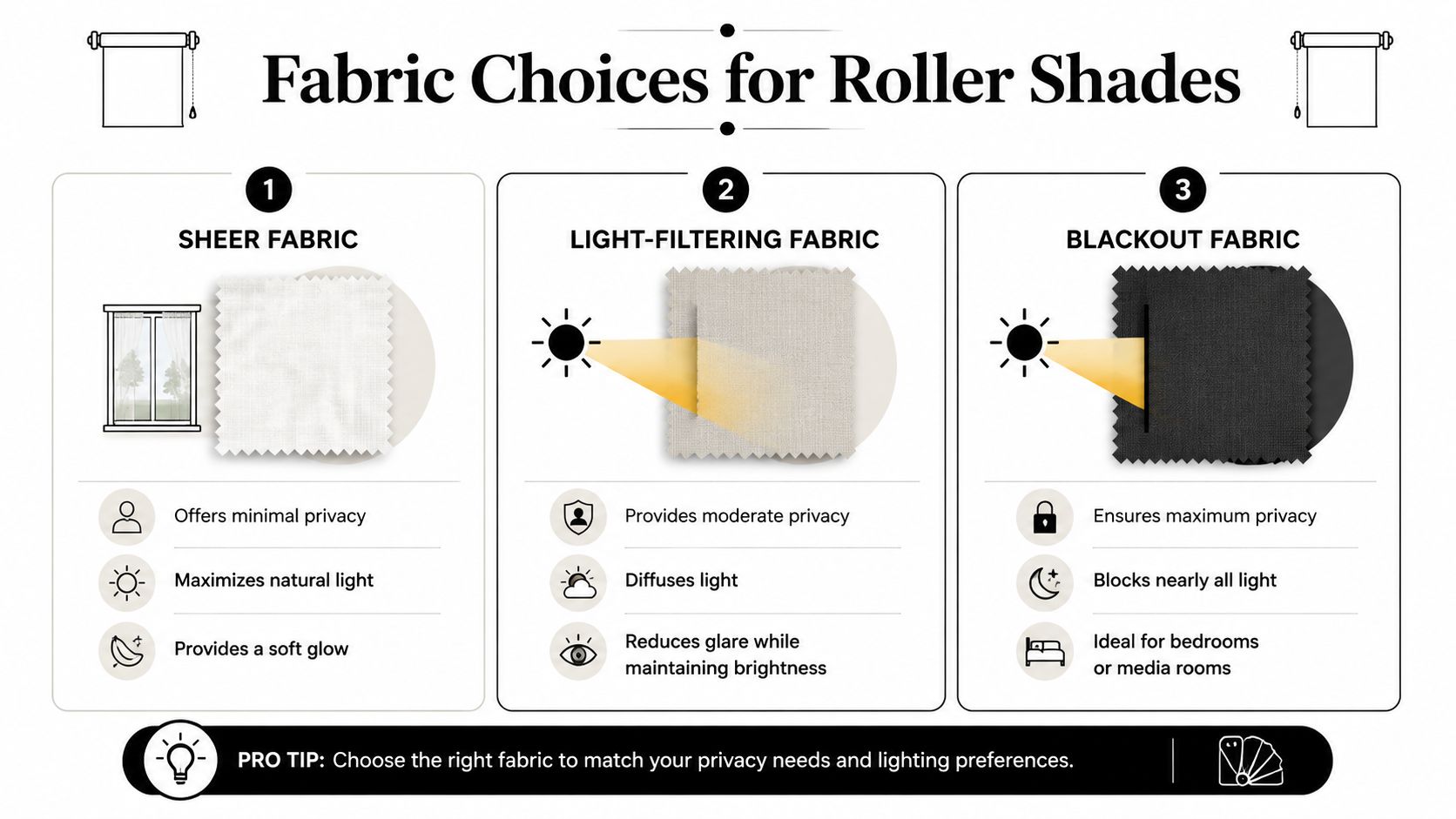
A fabric choice should answer one question first. What are you trying to fix: glare, visibility from outside, or full light block?
Solar fabrics for glare and daytime view
Solar-style fabrics are the pick when the room gets hammered by sun but you still want to see outside. They cut brightness and soften the harshness without turning the room gloomy.
These work well on backyard doors in family rooms, kitchens, and home offices. If you like daylight and just want less squinting, this category usually makes the most sense.
A lot of homeowners who start out asking for blackout don't need blackout. They need glare control.
Light-filtering fabrics for everyday living
Light-filtering fabrics are the middle ground. They soften incoming light, add privacy, and keep the room feeling open.
For most living spaces, this is the safest all-around choice. It doesn't feel heavy in the day, and it doesn't feel too exposed at night when fully lowered.
If you're comparing options, this overview of light-filtering roller shades is useful because it shows how these fabrics balance privacy with a softer look.
Blackout fabrics for privacy and darkening
Blackout fabrics are for rooms where you want maximum privacy and much stronger light block. On a sliding door, that often means bedrooms, media rooms, or spaces where evening privacy matters more than preserving a bright feel.
The caution is simple. Blackout fabric on a large patio door can feel visually heavy if the room is already short on natural light.
Here's the quickest way to sort the options:
| Roller Shade Fabric Comparison | Primary Goal | Best For |
|---|---|---|
| Sheer | Keep the space bright | Rooms where privacy is a lower priority and soft daylight matters most |
| Light-filtering | Balance privacy and brightness | Living rooms, dining areas, and everyday patio doors |
| Blackout | Maximise privacy and reduce light | Bedrooms, media rooms, and doors facing close neighbours |
How to decide without overthinking it
Use the room after dark as your test. If the lights are on and you'd hate being visible from outside, move away from sheer fabrics.
Also watch how you use the space during peak sun. If the problem is mostly afternoon glare on seating, floors, or screens, a view-preserving fabric often solves more than a room-darkening one.
- Choose solar-style fabric if the view matters and the main issue is brightness.
- Choose light-filtering if you want a forgiving, versatile option.
- Choose blackout if privacy and darkening matter more than softness.
Getting the Fit Right Mounts and Operating Options
Most problems with roller shades for sliding glass doors come from fit, not fabric. A beautiful shade that rubs the handle, hangs too low, or forces you to raise the whole thing every time someone steps outside will get old fast.
Precision in planning is essential at this point.
Inside mount or outside mount
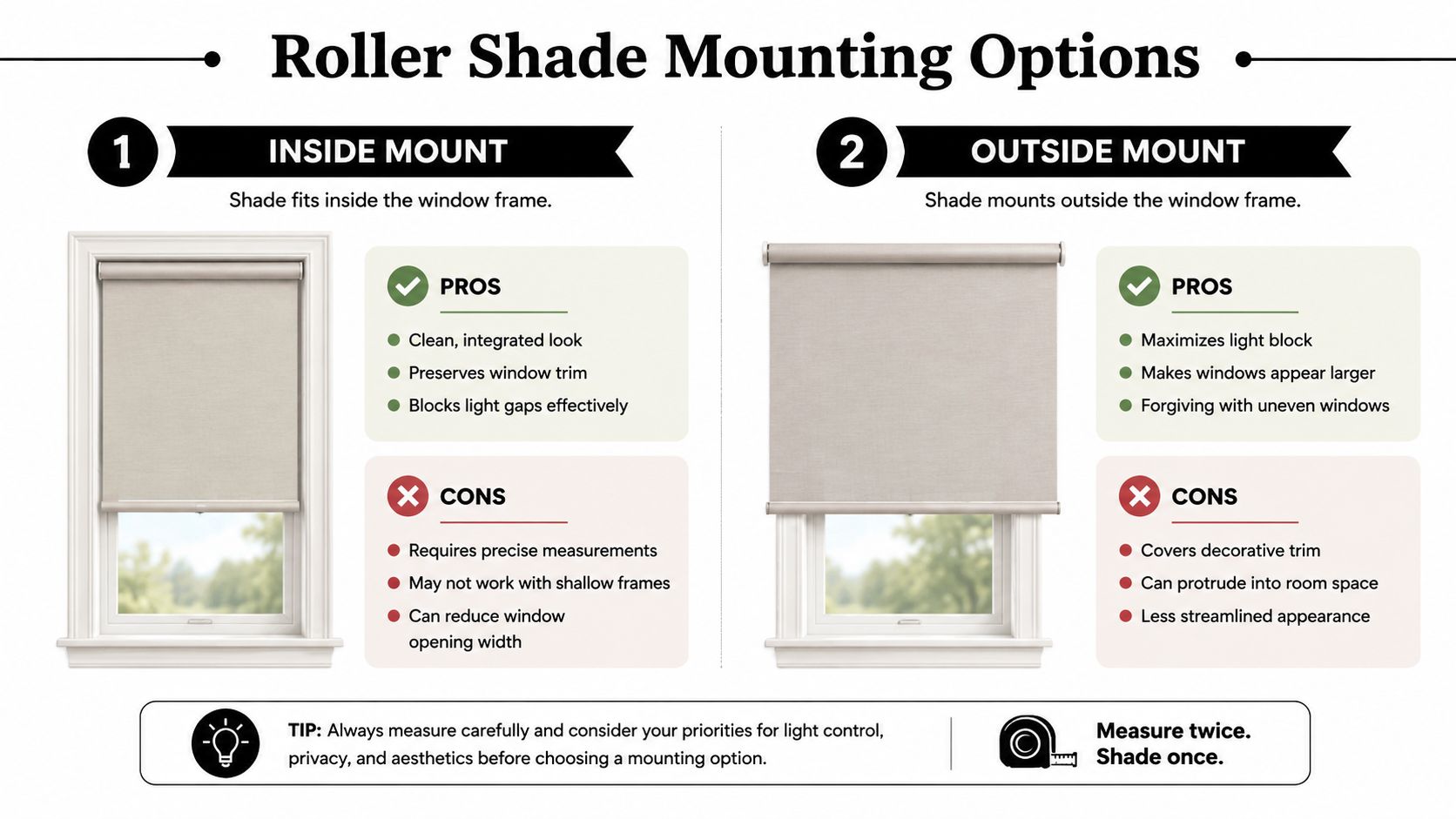
An inside mount sits within the frame or recess. It looks tidy and built-in, but it only works if the opening has enough depth and the shade can clear any hardware.
A detailed measuring video on roller shades for sliding doors notes that you should check handle projection, measure width and height in multiple places, and confirm a minimum inside-mount depth of about 1.5 inches. If depth is tight, outside mount is usually the better answer.
An outside mount is often the safer choice on patio doors. For sliding glass doors, a solid outside-mount setup typically overlaps the opening by about 2 to 3 inches on each side and places the header about 3 to 4 inches above the opening to reduce side light gaps and clear door hardware, based on this outside-mount measuring guidance.
If your handle sticks out, outside mount is usually where the conversation ends. You need room for the shade to travel freely.
One wide shade or two separate shades
This decision affects daily life more than most buyers expect.
One wide shade gives you the cleanest look. It reads as one uninterrupted panel, which suits large glass well. If your priority is symmetry and a simple visual line, this is usually the winner.
But a single wide shade also means one motion controls the entire opening. If someone uses the active door panel often, you may find yourself raising the whole shade more than you'd like.
Two separate shades break the opening into left and right sections. That can look slightly less continuous, but it's often much more practical.
Here's where two shades usually win:
- One side gets used more: Lower the fixed side, move the active side as needed.
- Light control needs vary: You can keep one half covered and one half open.
- Daily wear matters: Smaller shades are often easier to handle than one oversized panel.
If traffic flow matters more than minimalism, you may even want to compare panel track window blinds instead of forcing a roller shade solution.
The best-looking choice on day one isn't always the best-living choice by month six.
The handle test that saves you trouble
Before ordering anything, check three things on the actual door:
Handle projection
Stand to the side and look at how far the handle extends into the room. If it sits proud of the frame, the fabric and bottom bar need clearance.Door use pattern
Notice which panel people use. Most families have a “real” traffic side, even if both sides can technically move.Depth and obstructions
Watch for trim, locks, nearby walls, and anything that could interfere with the roll or bracket placement.
A lot of regret comes from buying based on width alone. On sliding doors, the mechanical path matters just as much as the measurement.
Control Your Shades Manual Motorized and Smart Home
Control choice matters more on a patio door than on a small bedroom window. A wide shade gets used often, and if the operation feels awkward, you'll notice it every day.
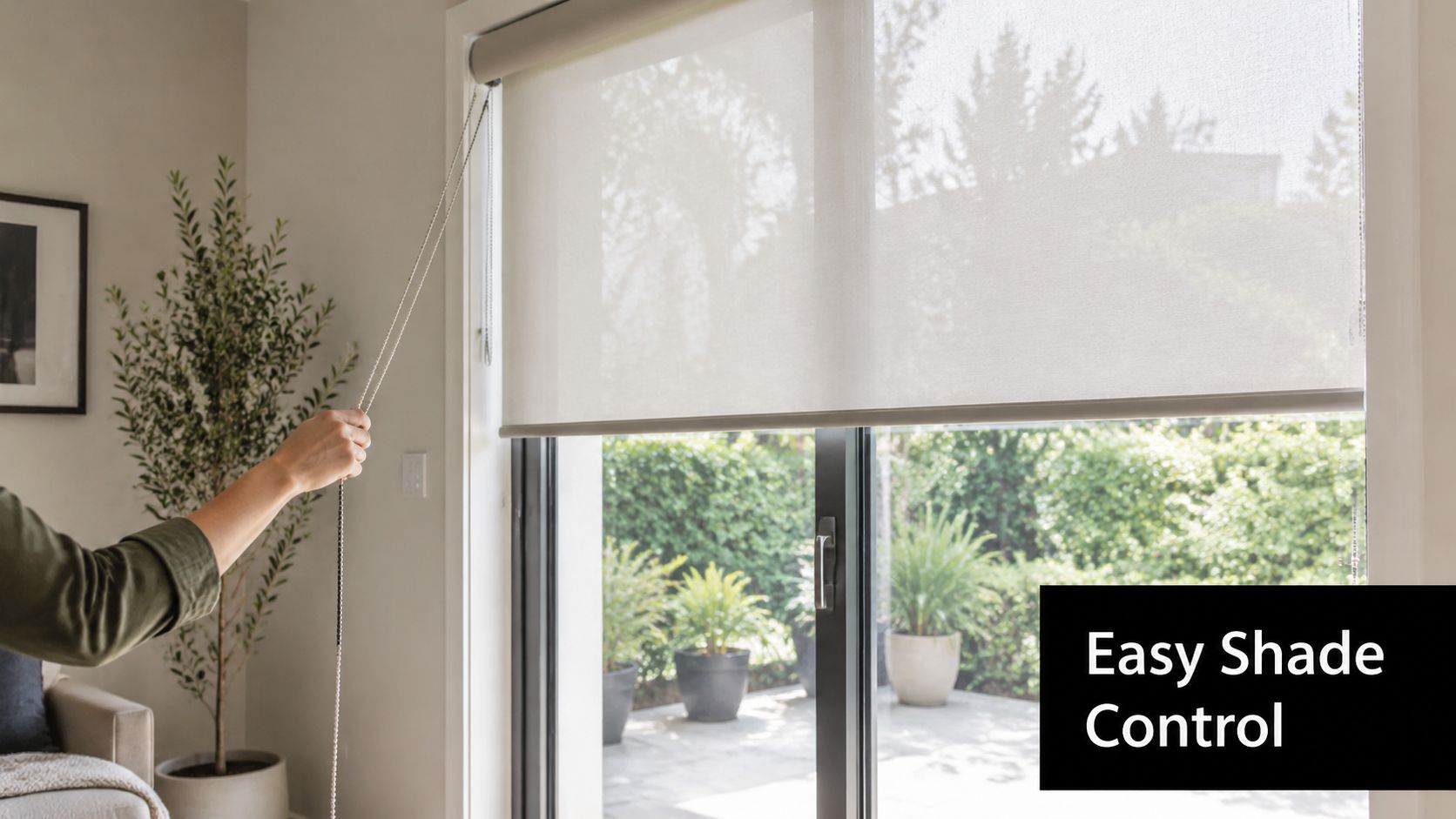
Manual control for simple reliable use
The standard manual setup is usually a clutch-operated system, often with a continuous loop. It's familiar, dependable, and a sensible choice if the shade isn't oversized and the household is comfortable using it regularly.
Manual control makes the most sense when you want to keep the project straightforward. It also works well when the shade will stay in one position for much of the day and only gets adjusted morning and evening.
That said, larger patio door shades are heavier than they look. The wider the fabric span, the more you feel that in daily operation.
Motorization for large shades and busy doors
Motorization earns its keep on large openings. Pressing a remote is easier than managing a heavier manual shade, especially when the door is used often or the mounting height puts the control slightly out of the way.
If you're comparing options, this page on motorization for blinds gives a good overview of why many homeowners move in that direction for bigger treatments.
Motorized control is especially practical when:
- The shade is extra wide: Less effort, less tugging, smoother movement.
- Kids use the door: Fewer cords and less rough handling.
- The door is a main exit: Quick operation matters when hands are full.
- You want consistent use: People are more likely to lower shades if it's easy.
A quick visual helps if you want to see motorized patio shades in action.
Smart home features build on that convenience. Remote controls are the simplest step up. App control, timers, and voice integration suit homeowners who already use connected devices and want the door shades to behave like part of the rest of the home.
What usually works best
For a modest-size door covering that gets occasional adjustment, manual control is fine.
For a wider shade, a higher mount, or a family that uses the door constantly, motorization often feels less like a luxury and more like the option that prevents frustration.
If a shade is large enough that you're already worrying about ease of use, you've probably answered your own control question.
Planning Your Project Durability Cost and Child Safety
A patio door shade has a tougher job than most window coverings. It spans a broad opening, gets handled more often, and has to keep tracking properly over time.
That means the planning shouldn't stop at colour and fabric.
What holds up on a wide opening
On wider roller shades, the hardware matters a lot. Architectural and manual roller shades are commonly built around tube sizes such as 1 1/8 inch and 2 inch, with clutch-controlled widths in one technical drawing set spanning roughly 18 to 120 inches, according to these roller shade technical drawings.
Why that matters is simple. Wider doors place more load on the tube and control system. The wrong setup can lead to more deflection, harder lifting, and poorer tracking over time.
When a buyer asks what makes one roller shade feel solid and another feel flimsy, this is usually part of the answer. Bigger openings need components sized for the job.
What changes the price
Price moves mostly on four things:
- Shade width: A larger opening uses more material and stronger hardware.
- Fabric type: Designer textures and specialty fabrics usually cost more than simpler options.
- Control system: Motorization adds cost compared with basic manual operation.
- Installation conditions: Tricky trim, limited depth, or unusual hardware can change the labour involved.
The easiest mistake is to budget only for fabric. On sliding doors, the operating system and mounting demands often shape the project just as much.
Safer choices for kids and pets
If children or pets use the room, safety should be part of the first conversation, not the last one. A patio door is an active area. That makes cords and loops more important to think through.
For many households, the most comfortable options are the ones that reduce or remove accessible cord hazards. Motorized setups are appealing for that reason, and cleaner manual solutions can also help depending on the product style.
A child-safe choice is usually the one that also feels easiest to live with.
There's also a durability benefit here. Fewer exposed control elements often means less tugging, less twisting, and less wear from everyday use.
Blinds Hut Makes It Simple
The difficulty isn't usually with choosing a colour. The struggle is with all the practical details around that colour. Will it clear the handle, should it be split into two shades, and will the fabric feel right in the room once the sun hits it in the afternoon?
That's where a proper in-home process saves a lot of second-guessing. Seeing samples against your flooring, wall paint, and trim tells you more in minutes than online browsing does in hours.
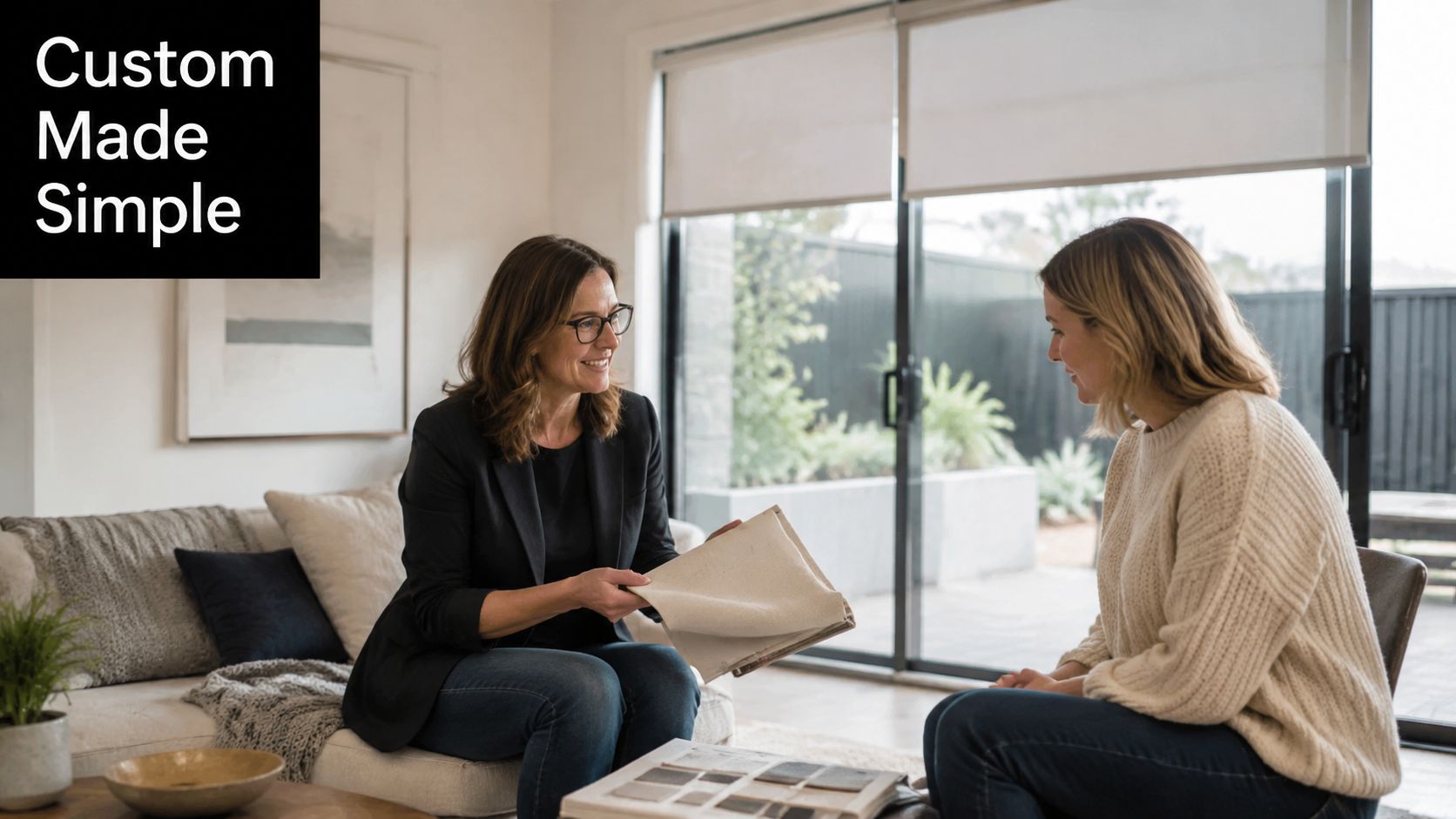
A good consultation also catches the things that cause regret later. Handle projection, bracket placement, side light gaps, and whether one large shade will become annoying on a busy door are all easier to judge on site.
Professional measuring matters even more on patio doors than on standard windows. Small errors are more obvious on a large span, and operation problems show up quickly.
If you want roller shades for sliding glass doors to feel simple, the product has to match the opening, the traffic pattern, and the way your household uses the space. That's what makes the final result feel custom instead of merely fitted.
Frequently Asked Questions
Are roller shades a good idea for every sliding glass door
No. They're a good fit for many doors, but not all. Existing guidance still often treats vertical or side-stacking options as the primary recommendation for sliding doors because they preserve door operation more naturally, as noted in this overview of patio and sliding door blind options.
If traffic flow and accessibility matter more than a minimal look, a vertical solution may be the better buy.
Is one shade better than two
It depends on how you use the door. One shade looks cleaner. Two shades usually give you better everyday flexibility if one side gets used more often.
Can roller shades clear a door handle
Yes, but only if the mount style and bracket projection are planned around the handle. That's one of the biggest reasons outside mount is common on patio doors.
What fabric is safest if I'm unsure
Light-filtering fabric is often the easiest starting point for a living area. It gives privacy and softens light without making the room feel closed off.
Are motorized shades worth it on a patio door
For a large or frequently used door, many homeowners think so. They're easier to operate and can make a wide shade feel much more manageable.
If you want help sorting out the right setup for your patio door, Blinds Hut makes the process easier with in-home consultation, fabric samples, precise measuring, and professional installation. It's a practical way to avoid handle-clearance mistakes, choose the right mount, and end up with a shade that works well every day.