Motorization for Blinds: A 2026 Homeowner’s Guide
You're probably looking at the same daily annoyance a lot of homeowners face. One blind is behind a sofa, another is above the stair landing, and the bedroom shade never seems to stop at the same height twice.
That's where motorization for blinds starts to make sense. It isn't just about adding a remote to your windows. It's about making light control easier, cleaner, and more reliable, especially when the blinds are used every day.
The tricky part is that most advice jumps straight to “smart home” features and skips the practical decisions. People need to know what motorization is, how it's powered, when retrofit kits make sense, and why professional selection and installation matter just as much as the motor itself.
Table of Contents
- What Is Blind Motorization and Why Is It So Popular
- Motor Systems Retrofit Kits vs Integrated Blinds
- Powering Your View Battery Wired and Solar Explained
- From Remotes to Voice Your Control Options
- Calculating the Cost and Value of Motorized Blinds
- The Blinds Hut Process Flawless Motorization Guaranteed
- Common Questions About Motorized Blinds
What Is Blind Motorization and Why Is It So Popular
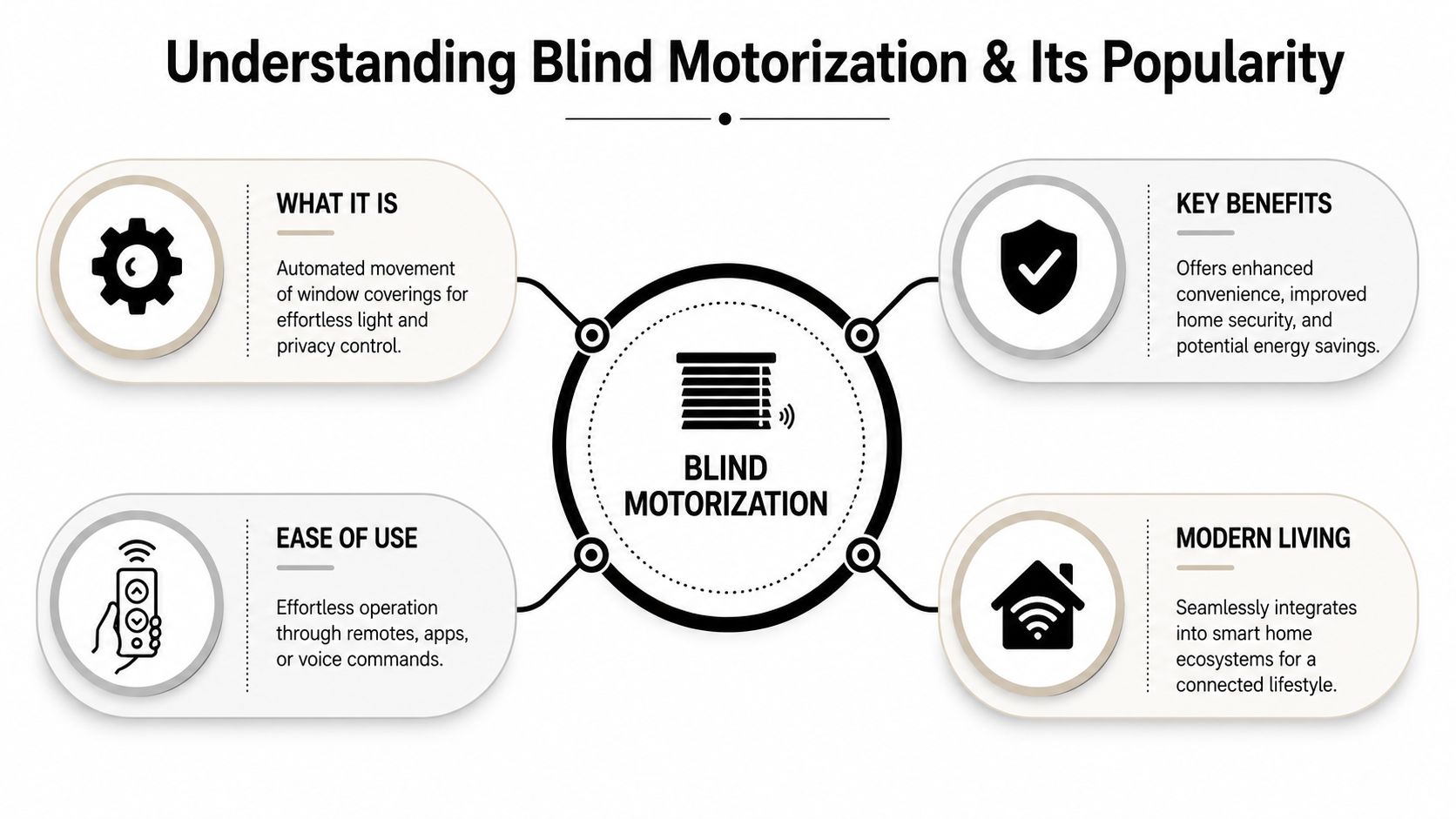
Motorization for blinds means a small powered system moves the blind for you. Instead of pulling a cord or twisting a wand, you use a remote, wall control, app, or voice command to raise, lower, or tilt the window covering.
For homeowners, that usually means smoother mornings, less reaching, and better control over privacy and glare. For anyone with tall windows, large shades, or limited mobility, it can turn an awkward job into a simple tap.
What motorization actually means
At the most basic level, a motorized blind has three parts. There's the blind itself, the motor that does the lifting or tilting, and the control method you use to tell it what to do.
A good way to think about it is a garage door opener in miniature. You're not changing the purpose of the product. You're changing how easily and consistently it operates.
Why it caught on so quickly
Convenience gets the attention first, but safety is one of the biggest reasons motorization became mainstream. Motorized blinds are closely tied to the move toward cordless window coverings, and that matters because safety rules pushed the industry away from hazardous lift cords.
One important marker came from the U.S. market, where a June 2024 cordless standard removed free-hanging operating cords for new window-covering installations and was described as eliminating about 9 child deaths per year from cord strangulation, according to this market overview on electric blinds.
Practical rule: If you want the cleanest way to remove accessible cords from daily use, motorization is one of the clearest solutions.
That safety shift also helps explain why buyers no longer see motorization as a luxury-only feature. In a family home, it solves a real problem. In a condo, it makes large windows easier to manage. In a home with aging family members, it can make day-to-day use much more comfortable.
Motorization also feels more normal now because people already use app control for lights, thermostats, and speakers. Once that mindset is in place, blinds don't feel like a strange thing to automate. They feel like the next logical part of the room.
Motor Systems Retrofit Kits vs Integrated Blinds
After deciding you want motorization, the first major choice is simple. Do you add a motor to something you already own, or do you buy a new blind with the motor built in from the start?
That's a bit like adding an aftermarket screen to an older car versus buying a vehicle with the system designed into the dash. Both can work. One is usually cleaner and more predictable.
The retrofit route
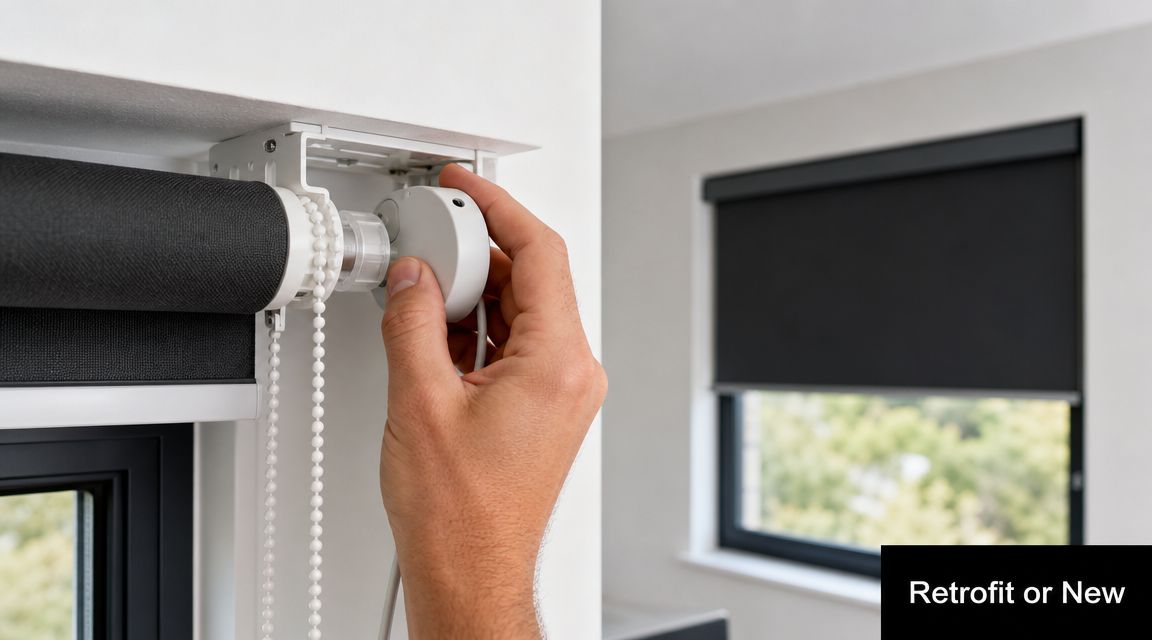
Retrofit kits appeal to people who want to keep an existing blind. If the blind is still in good shape and compatible with a motor, this can be a practical upgrade path.
The upside is obvious. You may avoid replacing every window covering at once, and the installation can be less disruptive in the short term.
The downside is fit and compatibility. Older blinds weren't always designed for powered movement, and small mismatches can create bigger problems over time. The bracket may not line up cleanly, the tube may not suit the motor, or the blind may be heavier than the retrofit motor likes.
The integrated route
Integrated systems are made as one package. The blind, tube, brackets, and motor are chosen to work together, so the finished result usually looks tidier and behaves more consistently.
That matters more than people expect. When the system is planned at the product level, you're less likely to deal with crooked rolling, uneven fabric tension, or visible add-on parts that make the blind look patched together.
A factory-integrated blind usually feels more like a finished product and less like a workaround.
This option tends to make the most sense when you're replacing outdated coverings anyway, furnishing a new home, or trying to keep several windows looking uniform in the same room.
Why motor sizing matters
The motor isn't chosen by guesswork. Professionals match it to the size, weight, and fabric of the blind.
For commercial and spec-grade motorized roller shades, one common configuration is a 24V DC low-voltage tubular motor with a minimum 2 N·m torque, according to this published motorized roller shade specification. In plain language, torque is the motor's lifting strength.
If the torque is too low, the blind may start slowly, strain during movement, or wear out faster. Heavier blackout fabrics and wider shades need more careful sizing than a small, light roller shade in a powder room.
When people say a motorized blind “works great” or “feels sluggish,” motor sizing is often the hidden reason.
Powering Your View Battery Wired and Solar Explained
Once you know what kind of motorized blind you want, the next question is how it gets power. Most homeowners end up choosing between battery, hardwired, and solar.
The best option depends less on trends and more on the room, the stage of the project, and how much maintenance you're comfortable with. A finished condo and a full renovation don't have the same needs.
Battery power in real homes
Battery-powered blinds are often the easiest starting point. They're popular in lived-in homes because installers can usually avoid opening walls or fishing wires through finished spaces.
That makes them a natural fit for retrofits, bedrooms, and single-room upgrades. If you want motorization without turning the house into a job site, battery power is often the least disruptive route.
The tradeoff is upkeep. At some point, the battery needs charging or replacement, so you're exchanging easier installation for some future maintenance.
Why hardwired systems appeal to planners
Hardwired low-voltage systems are often the cleanest long-term choice when the walls are already open. They suit new builds, major renovations, and larger projects where multiple blinds need to work together reliably.
Industry guidance identifies wired, battery, and solar as the three main power options, and notes that retrofits in finished homes often favour battery or solar to avoid complex wiring, while new builds can justify hardwired power for better scalability and fewer recharge cycles over the product life, as outlined in this guide to power options for motorized blinds and shades.
A hardwired setup tends to feel like built-in infrastructure. Once it's planned properly, you don't think much about it.
Where solar fits best
Solar-powered systems sit in the middle for many homeowners. They can reduce wiring complexity like battery systems, but they're designed to lower the maintenance burden by topping up power through light exposure.
They're especially appealing when the window gets suitable light and the homeowner wants a cleaner retrofit approach. If you're comparing solutions for a bright room, it helps to look at examples of solar roller shades to see how this setup fits into real window treatment design.
Here's the quick comparison individuals often need before deciding.
Power options for motorized blinds at a glance
| Feature | Battery-Powered | Hardwired (Low-Voltage) | Solar-Powered |
|---|---|---|---|
| Best fit | Existing homes and simple retrofits | New builds and major renovations | Retrofits with good light exposure |
| Installation | Usually the least invasive | Requires pre-planning and wiring access | Less wiring than hardwired systems |
| Maintenance | Battery charging or replacement | Very low day-to-day maintenance | Panel placement and system upkeep matter |
| Scalability | Good for room-by-room upgrades | Strong choice for larger whole-home systems | Useful where wiring is awkward |
| Look and finish | Clean when well planned | Often the most seamless overall | Clean retrofit option in the right setting |
Choose the power method based on the house you have, not the house you wish you had during installation.
From Remotes to Voice Your Control Options
It's common to start with the motor, then realize the true daily experience comes from the controls. A blind can have a great motor and still feel clumsy if the control method doesn't suit the household.
Think about a normal day. In the morning, you may want bedroom shades to open without getting out of bed. Midday, you might lower a living room shade to reduce glare. At night, you may want all the front-facing blinds closed with one command.
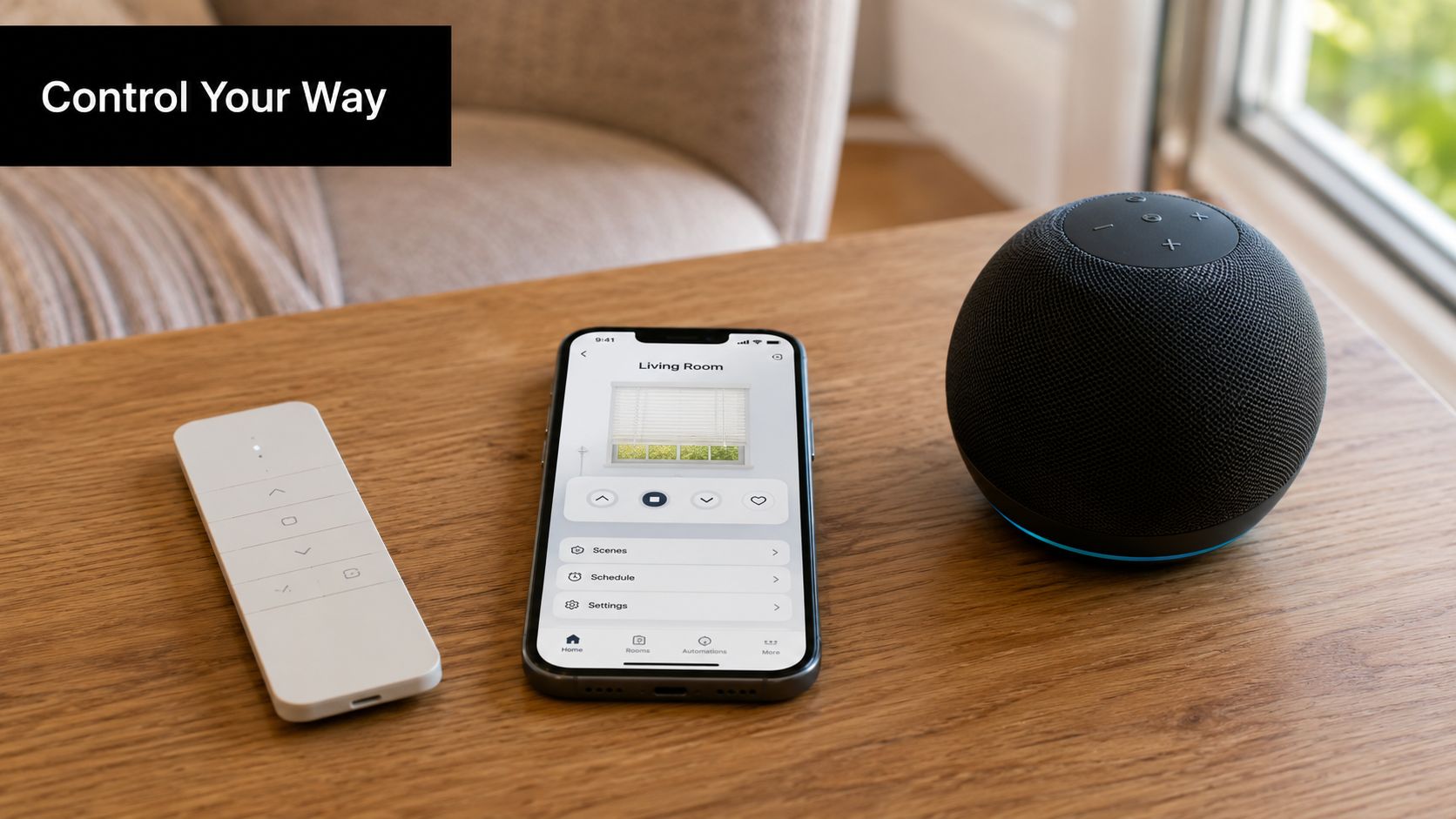
A normal day with motorized control
The handheld remote is still one of the easiest options to live with. It's familiar, fast, and simple for guests or family members who don't want another app.
Wall controls also make a lot of sense. They give you a fixed place to operate the blinds, which is helpful in busy rooms where remotes tend to disappear.
Then there's app control. That's where grouping becomes useful. Instead of opening five separate window coverings one by one, you can control a whole room at once.
If you want a simple starting point for that style of setup, many homeowners look at remote control operated blinds before deciding whether they also want app or voice features.
Choosing the right control style
Voice control gets the most attention because it feels modern, but scheduled automation is often what homeowners end up loving most. Once a routine is set, the blinds move when they're supposed to, and you stop thinking about them.
That's especially useful in rooms with strong afternoon sun, in media rooms, or for upper windows that don't get adjusted manually very often.
Here's a quick visual look at how these control options fit into a connected home.
A good rule is to match control style to behaviour.
- Remote first: Best when you want something easy and low learning.
- Wall switch: Great for shared rooms and predictable access.
- App control: Helpful when you want grouping, off-site access, or routines.
- Voice control: Convenient when your hands are full or the blinds are part of a wider smart-home setup.
- Schedules: Ideal when you want the room to manage light on its own.
The smartest system isn't the one with the most features. It's the one people in the house will use.
Calculating the Cost and Value of Motorized Blinds
Cost is usually the point where homeowners pause. That makes sense, because motorization adds more than one variable at once. You're not only choosing fabric or slat style. You're also choosing a motor, a power method, and a control system.
The better way to judge the price is to separate cost from value. Cost is what you pay upfront. Value is what you get every day after installation.
What changes the price
A few things have an outsized effect on the final number.
- Window size and weight: Bigger blinds often need stronger motors and more careful installation.
- Blind type: Roller shades, zebra shades, and tilt-based products don't all use motorization the same way.
- Power source: Battery, hardwired, and solar systems have different installation demands.
- Controls: A single remote setup is simpler than a fully grouped smart-home system.
- Access difficulty: High windows, wide openings, and specialty mounting conditions usually add complexity.
These aren't “extras” in the annoying sense. They're the pieces that determine whether the blind feels smooth and dependable or awkward and underpowered.
Where the value shows up
The strongest value often shows up in rooms that are hard to manage manually. Bedrooms, media rooms, offices, and tall foyer windows are common examples.
Motorization can also improve the feel of the space. Quiet operation matters here. Fortune Business Insights estimates the global blinds and shades market at USD 7.51 billion in 2026, growing to USD 9.85 billion by 2034 at a 3.44% CAGR, with North America accounting for 50.70% of the market in 2025. The same market context notes that modern motorized blinds commonly operate at about 38 to 50 dB, with premium DC-motor models around 35 to 38 dB, which helps explain why they're accepted in bedrooms, offices, and open-plan homes where noise matters, according to Fortune Business Insights on the blinds and shades market.
Quiet motors don't just sound better. They make automation feel normal instead of mechanical.
There's also the value of consistency. A manually adjusted blind often stays half-used because nobody bothers with it. A motorized one gets used properly because it's easy.
That can matter in a home office where glare affects screens, in a bedroom where darkness matters, or in a living room where afternoon sun changes the comfort of the space. The blind only helps if people operate it.
The Blinds Hut Process Flawless Motorization Guaranteed
Motorization can be simple to use and still be technical to specify. That's why the buying process matters almost as much as the product.
A homeowner usually sees the finished blind and the remote. A professional sees window depth, mounting surface, shade weight, access to power, signal reliability, and whether the control style fits the people living in the home.
Why professional planning matters
A lot can go wrong before the first blind is even installed. Wrong motor strength, poor bracket placement, awkward power planning, or a control setup that looks good on paper but frustrates the homeowner in daily use.
A complete provider proves its worth. Proper selection begins with the room, not the brochure.
For example, a blackout shade in a bedroom may call for one type of motor setup, while a solar shade in a bright living room may call for another. A tall stairwell window needs a different conversation than a kitchen window over the sink.
What a complete service should include
A strong process usually includes these steps:
In-home consultation
Someone needs to see the actual space. Light direction, furniture placement, trim details, and wall conditions all affect the recommendation.Product and control matching
The right blind has to suit both the window and the user. Some people want one remote. Others want grouped controls or smart-home integration.Precise measuring
Motorized blinds don't hide measurement mistakes well. A clean fit matters for both appearance and performance.Certified installation
Motors, brackets, and limits need to be set correctly. A poor install can make even a good product feel unreliable.Programming and handover
Homeowners should leave the appointment knowing how to use every control method confidently.
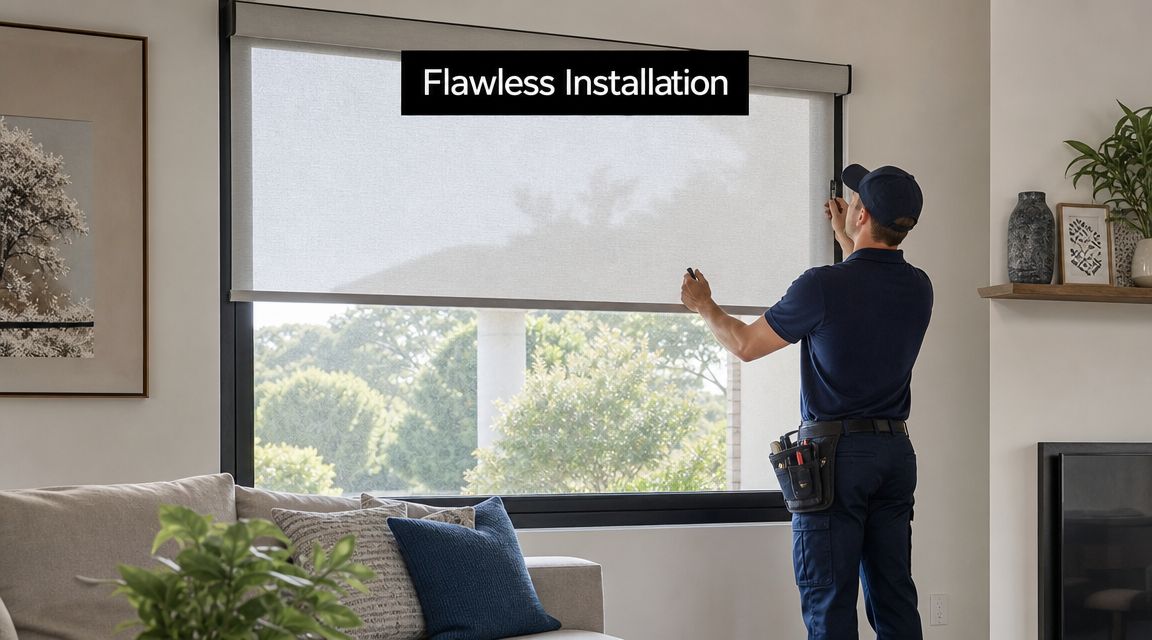
Good motorization feels effortless because someone handled the technical details before you ever touched the remote.
If you want to see what a local end-to-end service looks like in practice, this page on motorized blinds in London, ON is a useful example of how selection, measuring, installation, and setup come together.
DIY can work in narrow situations, especially with simple retrofit products. But once you're dealing with multiple windows, specialty sizes, hidden wiring, or integrated controls, professional planning usually protects the long-term value of the investment.
Common Questions About Motorized Blinds
Even after you understand the basics, a few practical questions tend to come up right away. Most of them come down to maintenance, troubleshooting, and whether motorization is worth it on unusual windows.
Do motorized blinds need a lot of maintenance
Not usually. Most systems need the same basic care as manual blinds. Keep the fabric or slats clean, avoid forcing movement by hand if the product isn't designed for it, and pay attention to the power source.
Battery and solar setups need occasional power checks. Hardwired systems need less day-to-day attention, but they still benefit from periodic testing so you catch small issues before they become annoying ones.
What should you check if a blind stops responding
Start with the simple stuff first.
- Power check: Make sure the battery is charged, the solar accessory is positioned properly, or the wired connection hasn't been interrupted.
- Control check: Confirm the remote, wall control, or app is still paired and functioning.
- Obstruction check: Look for fabric bunching, debris in the path, or anything physically blocking movement.
- Reset step: Follow the manufacturer's reset or re-pairing process if the blind has power but won't respond.
If the blind strains, hesitates, or moves unevenly, stop using it until someone checks it. Continuing to run a struggling system can make a small issue harder to fix.
Are specialty windows worth motorizing
Often, yes. In some cases, motorization is less of a luxury and more of a practical solution.
That's especially true for arches, angled windows, triangles, skylights, and other hard-to-reach shapes. Suppliers that focus on unusual window forms note that motorized operation is commonly selected for these applications, and that different shapes may require battery-operated, plug-in, low-voltage, AC, or hardwired configurations. They also point out that motorization is often a practical necessity, not just a convenience, for specialty windows where daily operation would otherwise be difficult, as discussed by specialty window experts covering arched and angled blinds.
If a window is difficult to reach or awkward to operate, motorization may be the feature that makes the blind usable every day.
That's also where expert guidance matters most. Specialty windows bring extra questions about privacy, light leakage, mounting space, and control strategy. A standard answer usually isn't enough.
If you're weighing motorization for blinds and want clear advice without the guesswork, Blinds Hut can help you compare products, power options, and control styles in your actual space. Their team handles consultation, measuring, and certified installation, so you end up with a system that looks right, works smoothly, and fits how you live.