Window Zebra Blinds: A Complete Homeowner’s Guide
You're probably here because you like the clean look of modern shades, but you don't want to live in a fishbowl.
That's the exact spot many homeowners hit. Curtains can feel heavy, roller shades can feel all-or-nothing, and basic blinds often leave you constantly tilting, lifting, and readjusting. Window zebra blinds sit in the middle. They let you soften daylight, keep a view when you want one, and switch to more privacy without changing the whole look of the room.
They're especially appealing when a room has to do more than one job. A front living room needs daylight in the afternoon. A home office needs glare control. A bedroom needs better privacy at night. That's where critical questions start, and those questions matter more than the showroom pitch.
Table of Contents
- Finding the Perfect Balance of Light and Privacy
- What Are Zebra Blinds and How Do They Work
- Exploring Styles Materials and Custom Options
- Zebra Blinds vs Other Window Treatments
- Motorized and Smart Zebra Blind Options
- Measuring and Installation Considerations
- Why Choose Blinds Hut for Your Zebra Blinds
- Frequently Asked Questions About Zebra Blinds
Finding the Perfect Balance of Light and Privacy
A common scene goes like this. You open the window covering in the morning because the room feels dim, then a few minutes later you realize the whole street can see in. So you close it again, and now the room feels flat and shut off.
Window zebra blinds are built for that in-between moment. Instead of choosing open or closed, you can shift the fabric bands until the room feels right for the time of day.
A front sitting room is a good example. During the day, you may want soft light and some view out to the yard, but not full exposure to pedestrians or neighbours. In the evening, you may want more coverage without swapping to a second treatment right away.
Practical rule: If you keep asking for both brightness and privacy from the same window, zebra blinds are worth a serious look.
They also fit the way many homes are used now. One room can be a lounge, office, homework space, and TV room in the same week. A window treatment that adjusts in small steps often feels more useful than one that only has two clear positions.
What Are Zebra Blinds and How Do They Work
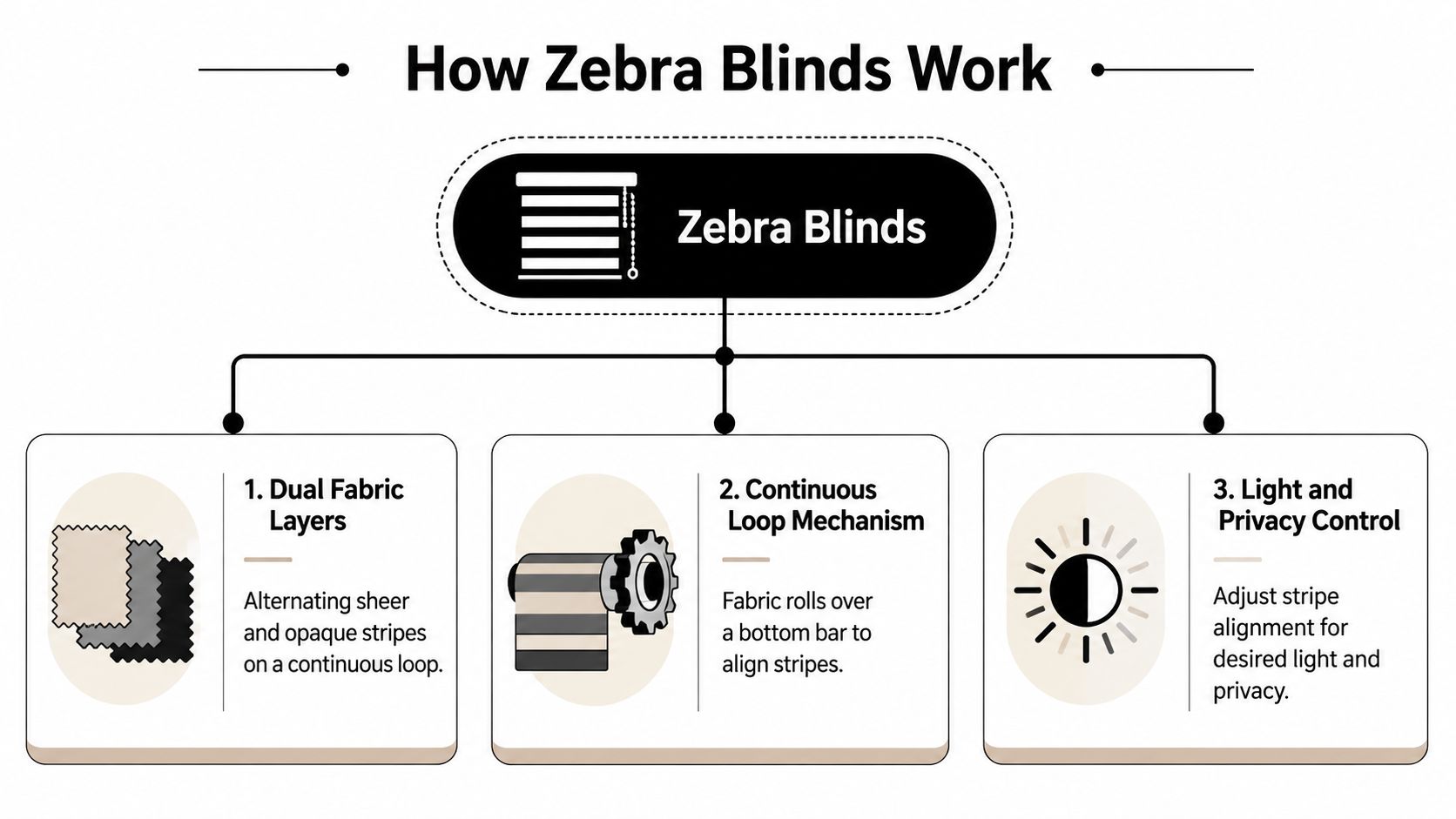
Zebra blinds are easiest to understand if you picture two striped fabric panels traveling together on one roller. Instead of tilting slats like a blind or dropping one solid sheet like a standard shade, the fabric shifts so the stripes line up in different ways.
A roller shade idea with more control
They grew out of the roller shade family, but the experience is different. Traditional roller shades have been around for centuries, including examples documented in 17th century Holland, according to this history of roller shades. Zebra blinds took that basic roll-up format and changed the fabric itself by alternating sheer bands with more opaque bands.
That design gives you finer control during the day. You are not choosing only fully open or fully closed. You are adjusting how the stripes overlap, which changes light, view, and privacy in small, useful steps.
What the fabric is actually doing
A lot of homeowners assume the sheer stripe means no privacy and the solid stripe means privacy. However, the answer is a little more nuanced.
Zebra shades use a continuous loop of fabric on a roller system, so the two striped layers pass in front of each other as you raise or lower the shade, as explained in this guide to zebra shades. As those layers shift, the room changes with them.
Here are the three positions people use most often:
- Sheer-aligned: The sheer bands line up, so you get the brightest look and the clearest view out.
- Partially offset: The stripes overlap partway, which softens glare and gives more screening.
- Solid-aligned: The opaque bands cover more of the opening, which increases privacy and reduces incoming light.
A good analogy is two window screens sliding past each other, except some parts are more open and some parts are more covered. Small adjustments can make a noticeable difference.
What that means in real rooms
Zebra blinds behave differently from what many shoppers expect the first time they see them online. They do not “close” in the same way mini blinds close, and they do not always give full nighttime privacy in every fabric.
During the day, they are often very effective for managing light while limiting direct views in from outside. At night, if the room is lit and the blind is in a sheer or partly open position, visibility from outside can increase. In the more closed position, privacy improves, but the exact result depends on the fabric, color, and interior lighting. That is one of the biggest practical questions homeowners should ask before buying.
Another common question is whether they are best for every room. Usually, no. Zebra blinds are often a strong fit for living rooms, dining rooms, kitchens, and home offices where adjustable daylight matters more than full blackout performance. Bedrooms and media rooms can still use them, but many homeowners prefer a blackout version or add drapery if they want stronger room darkening and more nighttime coverage.
Window coverings have a long history that reaches back thousands of years, with records tied to Ancient Egypt around 3000 BC and later blind styles appearing centuries after that, as outlined in this window treatment history overview. Zebra blinds are one of the newer versions of that same basic goal: control the light, keep comfort in the room, and give you more say over how exposed the space feels.
Exploring Styles Materials and Custom Options
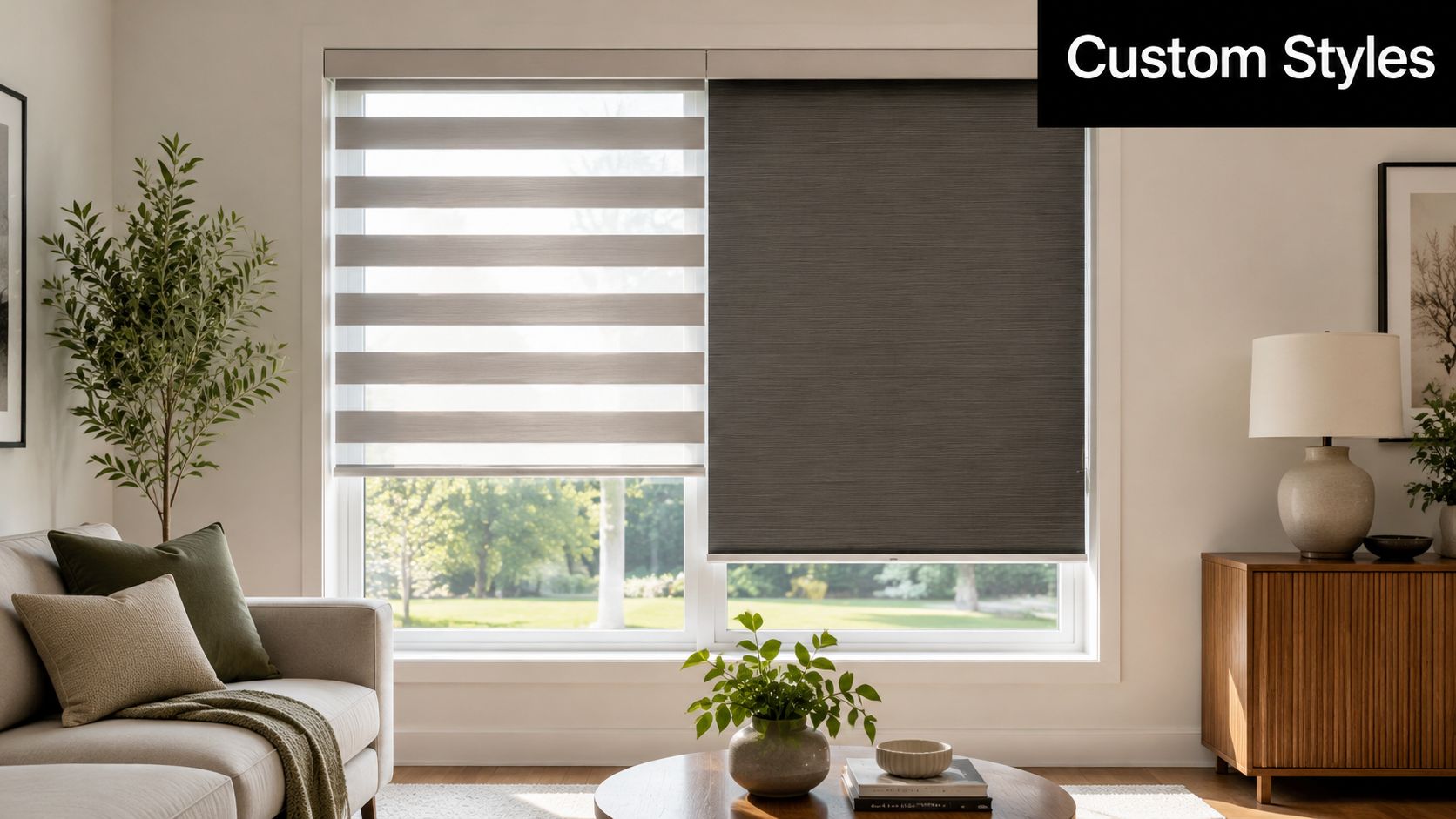
Style matters with zebra blinds because they stay visible even when raised. They're not just a functional layer. They become part of the room's lines, colour palette, and light quality.
Light-filtering fabrics
Most zebra blinds you see in living rooms are light-filtering. These fabrics soften sunshine, reduce harsh glare, and keep the room from feeling closed off.
They work well in spaces where you still want the daylight to feel present. Think kitchens, family rooms, dining areas, and home offices that don't need full darkness.
When you're choosing a fabric, look at more than colour. The stripe width changes the look. The weave changes how soft or crisp the light feels. A warm neutral can make a north-facing room feel gentler, while a cooler tone can sharpen a clean, modern interior.
A few details to compare side by side:
- Colour tone: White and pale beige often feel airy. Charcoal and deeper greys look sharper and more architectural.
- Texture level: Smooth fabrics feel contemporary. Subtle woven texture feels softer and a bit more relaxed.
- Stripe scale: Wider bands create a bolder pattern. Narrower bands usually blend in more subtly.
Blackout fabrics and finishing details
If the room needs stronger darkness or more privacy, look at blackout zebra fabrics rather than standard light-filtering material. They're often a better fit for bedrooms, nurseries, and media spaces.
That doesn't mean every blackout option looks heavy. Many still keep the clean striped appearance that makes zebra blinds popular in the first place.
The headrail finish also changes the final look. Some homeowners prefer a more open roller appearance. Others like a cassette or valance that hides the top hardware and gives the shade a tidy, built-in feel.
A cassette can make zebra blinds look more finished, especially in rooms with clean trim and modern furnishings.
If you're matching blinds across several rooms, consistency helps. You can vary the fabric type by room but keep the cassette style and colour family similar so the home still feels organised.
Zebra Blinds vs Other Window Treatments
Quick comparison table
Here's a simple side-by-side view of the options homeowners compare most often.
| Feature | Zebra Blinds | Roller Shades | Venetian Blinds |
|---|---|---|---|
| Light control flexibility | Adjustable in small increments through band alignment | Usually more open or more closed, depending on fabric | Adjustable by tilting slats |
| Daytime view | Often allows softened view through | Depends on fabric choice | Partial view through slats |
| Privacy control | Good daytime flexibility | Depends heavily on fabric opacity | Can be adjusted, but slat angles matter |
| Look | Soft, modern, layered | Clean and minimal | More structured and traditional |
| Cleaning | Fabric needs gentle dusting | Usually simple to wipe or dust | Slats collect dust more visibly |
| Best fit | Rooms needing both daylight and privacy | Rooms needing simplicity or stronger blackout options | Rooms where slat tilt control is preferred |
If you like the clean face of a roller shade but want more flexibility during the day, zebra blinds usually make more sense. If you already know the room needs a very straightforward fabric drop, light-filtering roller shades may be a simpler alternative.
Which option fits which room
Roller shades are often the easiest pick for a spare room, office, or space where you want a very plain window line. They do one thing well and don't draw much attention.
Venetian blinds still work for people who like slat control and a more classic blind feel. They're familiar, and some homeowners prefer being able to tilt rather than move layered fabric.
Zebra blinds stand out when the room changes use throughout the day. That's why they're so common in front rooms, open-concept living areas, and work-from-home spaces. You can shift the setting as the sun changes without fully losing daylight.
What happens at night
This is the question many product pages skip. Are zebra blinds private at night?
The honest answer is, sometimes, but not always enough. Privacy depends on band position, fabric opacity, and what's happening inside the room. If lights are on indoors, visibility from outside can increase, especially in rooms facing the street.
A design guide notes that homeowner concern about nighttime privacy is common, and it points out that when interior lights are on, privacy can be reduced. It also notes that blackout versions are often the better specification for bedrooms or street-facing windows, as explained in this zebra shade privacy guide.
That leads to a simple room-by-room rule:
- Bedroom: Choose blackout zebra blinds or layer with drapery if privacy is sensitive.
- Front living room: Standard zebra blinds may work in the day, but consider layering if the room is bright at night.
- Basement: Standard zebra blinds can work well if privacy pressure is lower.
- Media room: A different blackout-first product may be the stronger fit if darkness matters most.
If your main concern is nighttime privacy, don't judge zebra blinds only by how they look in a bright showroom.
Motorized and Smart Zebra Blind Options
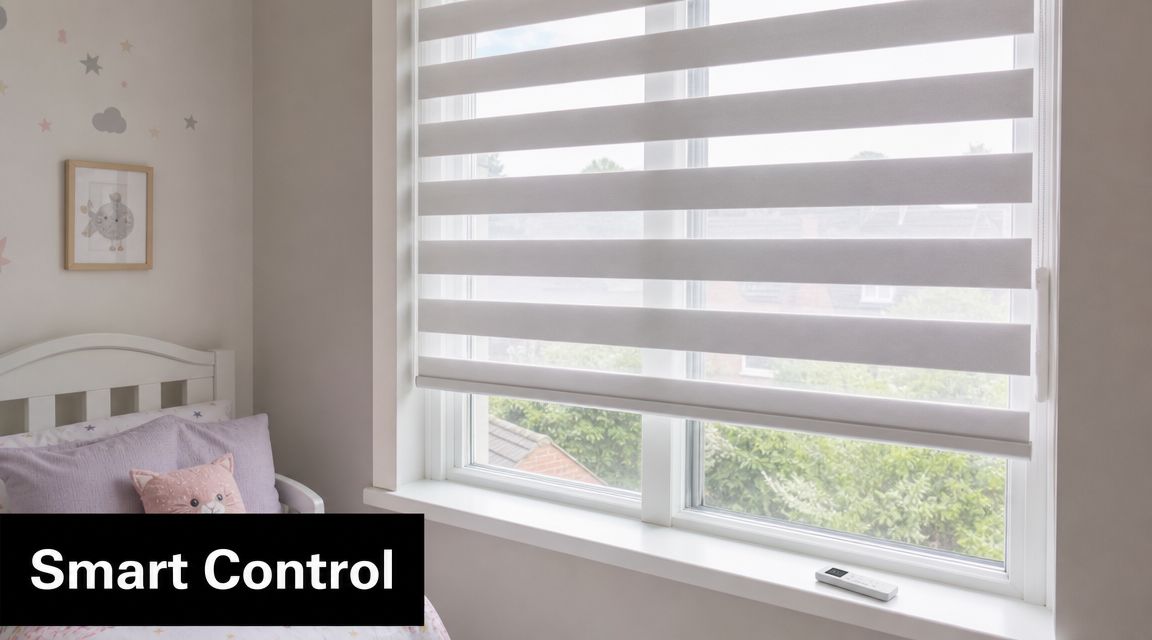
Motorization changes the feel of zebra blinds more than people expect. The fabric moves smoothly, stops more precisely, and the whole treatment looks cleaner without hanging cords.
Why motorization changes daily use
The first benefit is convenience. Tall foyer windows, wide living room windows, and windows behind furniture are much easier to use when you don't have to reach awkwardly every day.
The second benefit is a cleaner setup for homes with kids or pets. Many homeowners also prefer the uncluttered look of a cordless treatment in newer interiors.
Motorization can also help you use the blinds the way they're meant to be used. Instead of leaving them in one fixed position for weeks, you're more likely to fine-tune light and privacy because it's effortless.
Here's a quick look at a motorized setup in action.
Control choices that make sense
You don't need a fully automated home to use motorized zebra blinds. Some people are happiest with a simple handheld remote. Others want wall controls, app control, or voice integration through existing smart-home systems.
A few common reasons homeowners choose this upgrade:
- Hard-to-reach windows: Great for stairwells, vaulted spaces, and windows behind tubs or desks.
- Daily routines: Handy when you like blinds open in the morning and more private later on.
- Cleaner sightlines: No dangling controls, which suits modern rooms well.
If you're comparing options, take a look at remote control operated blinds to see the kinds of setups available for everyday use.
Measuring and Installation Considerations
A zebra blind can look perfect in a showroom and still feel disappointing at home if the measurements are even slightly off.
That happens because zebra blinds are layered. The headrail needs enough space, the fabric has to roll cleanly, and the bands need room to line up properly. A standard single-layer shade is often more forgiving. Zebra blinds are less forgiving, which is why mount choice matters first.
Inside mount or outside mount
An inside mount fits within the window frame. Homeowners usually choose it for a trim, built-in look that keeps the blind visually tidy.
An outside mount installs on the wall or trim above the window. It is often the better answer when the frame is shallow, the opening is a little uneven, or you want better edge coverage for privacy and light control.
Here is the part that trips people up. An inside mount is not automatically the better-looking option if the window does not have enough depth. One zebra blind product guide states that an inside-mount blind needs a minimum window depth and a width clearance deduction of 3 to 5 mm, and it lists maximum sizes of 2,700 mm width and 3,000 mm drop for most fabrics, with 2,800 mm for blackout fabrics, plus a reduced maximum drop of 2,650 mm when fabrics are railroaded (zebra blind product information guide).
In plain terms, the blind may fit the opening on paper but still not sit the way you expect once brackets, fabric, and roll size are factored in.
Where measurements go wrong
Width is a common problem. If the blind is ordered too tight for an inside mount, it can rub the frame or move less smoothly. If it is ordered too narrow, you may notice side gaps more than you expected, especially in bedrooms and street-facing rooms.
Depth is the other big one. Homeowners often focus on width and height, then realize too late that the window frame is not deep enough for a clean recessed fit.
A few practical checks help before you order:
- Measure the width in three places: top, middle, and bottom, because window openings are often slightly uneven.
- Measure the height in three places: left, center, and right, then use the correct measurement based on the mount type.
- Check depth before committing to an inside mount: this decides whether the blind can sit properly within the frame.
- Consider the room's privacy needs: if nighttime privacy and better coverage matter, an outside mount is often the safer choice.
- Watch for trim, handles, and nearby obstacles: these small details can affect bracket placement and how the blind hangs.
A good way to think about it is like buying a fitted sheet. The mattress width matters, but depth matters too. If the depth is wrong, the fit never feels right.
If you want a visual walkthrough before deciding whether to DIY, this step-by-step guide on how to install zebra blinds is a useful place to start.
Why Choose Blinds Hut for Your Zebra Blinds
A zebra blind can look great in a photo and still be the wrong fit once it is on your window. That usually happens for practical reasons. The fabric lets in more evening visibility than you expected, the color reads differently in your room, or the blind was ordered for an inside mount when the window really needed wider coverage.
That is why specialized help matters with zebra blinds. They are a custom product with moving fabric layers, so good results depend on more than picking a color you like. You also need the right level of privacy for the room, the right mount style for the window, and a setup that works well day after day.
Homeowners often ask the same real-world questions. Will these feel private enough in a front living room at night? Will the bands line up neatly on a wide patio door? Will this soft white fabric still look warm once afternoon sun hits it? Those are the details that shape whether you love the finished result or wish you had chosen differently.
A good provider helps you answer those questions before you order, not after the blind is installed.
What that looks like in real life
Helpful service usually includes guidance that is specific to your room and your routine, such as:
- Room-based recommendations: A family room, bedroom, office, and rental unit often need different levels of light control and privacy.
- Sample review at home: Zebra fabrics can shift in appearance depending on wall color, flooring, and natural light.
- Clear advice on privacy limits: This matters if you like the zebra look but need stronger nighttime coverage in certain rooms.
- Installation planning: Large windows, inside mounts, and motorized blinds all benefit from careful setup before the order is placed.
Blinds work a lot like paint samples. A choice that seems perfect under store lighting can feel very different once it is in your own home, next to your trim, furniture, and daylight.
For homeowners in London, Ontario, Blinds Hut offers made-to-measure zebra blinds with in-home consultation, product guidance, measurement, and installation support.
Frequently Asked Questions About Zebra Blinds
Are zebra blinds hard to clean
Not usually, but they do need a gentle approach. Regular dusting with a soft cloth, feather duster, or vacuum brush attachment works better than aggressive scrubbing.
Because the fabric includes sheer sections, it's smart to avoid soaking the material or using harsh cleaners. Light, routine care is usually the easiest way to keep them looking good.
Can you use zebra blinds in bathrooms
They can work in some bathrooms, but the room conditions matter. If the bathroom is well ventilated and the blind won't sit in constant dampness, zebra blinds may be fine.
For high-moisture spaces, ask about fabric suitability before ordering. In some bathrooms, another product may be a safer long-term choice.
Do zebra blinds make a room fully dark
Standard zebra blinds usually don't. They're designed for adjustable light control, not total blackout.
If you want stronger darkness for sleeping, choose a blackout zebra fabric or layer the blind with drapery. That's often the better answer for bedrooms, nursery windows, and street-facing rooms where privacy is also a concern.
Are zebra blinds good for living rooms
Yes, often very good. Living rooms are one of the clearest use cases because they usually need changing levels of daylight and privacy over the course of the day.
They're especially handy in front-facing rooms where you want the space bright during the day without leaving the window fully exposed.
Are zebra blinds worth it for large windows
They can be, especially when you like the soft modern look and want flexible daylight control across a wider opening. For larger windows, the details matter more, including fabric size limits, mount choice, and whether motorization would make daily use easier.
If the window is especially wide or tall, it's worth confirming the product specs before ordering.
If you're comparing window zebra blinds for a bedroom, front room, office, or rental property, Blinds Hut can help you sort out the practical details, from fabric choice and privacy needs to measuring and installation, so you can choose a setup that fits your space and how you use it.