

Blinds for Large Windows: A Practical Buyer’s Guide 2026
You bought the house for the light. Then summer hit, the afternoon glare took over the living room, and that big beautiful window started feeling like work. Or maybe it's the patio door blind that never quite closes right, leaves a strip of light at the edge, and gets harder to pull every month.
That's usually the point where people realise large windows need a different approach. Standard sizes and off-the-shelf hardware can look fine on the shelf, but wide spans expose every weakness. You notice sagging, crooked rolling, awkward gaps, and controls that no one wants to touch twice a day.
In Ontario, this comes up all the time because large windows are common across newer homes, condos, and renovated spaces. Canada had 16,786,475 private dwellings in the 2021 Census, and Ontario alone had 5,699,700 private dwellings, which helps explain why demand for custom solutions isn't niche at all, as noted in this overview of large window coverings in Canada.
Table of Contents
- Big Windows Big Problems? Let's Find a Solution
- Choosing Your Champion The Best Blind Types for Wide Spans
- Light Privacy and View What Matters Most to You
- Go Smart The Guide to Motorized Blinds for Large Windows
- Getting the Perfect Fit Measurement and Mounting Explained
- Beyond the Blinds Styling and Practical Extras
- Making the Investment Cost and Finding the Right Partner
Big Windows Big Problems? Let's Find a Solution
A common call goes like this. “We love the window. We hate living with it.” That usually means one of three things: too much glare, not enough privacy at night, or a blind that feels heavy and clumsy because it was never the right product for the width.
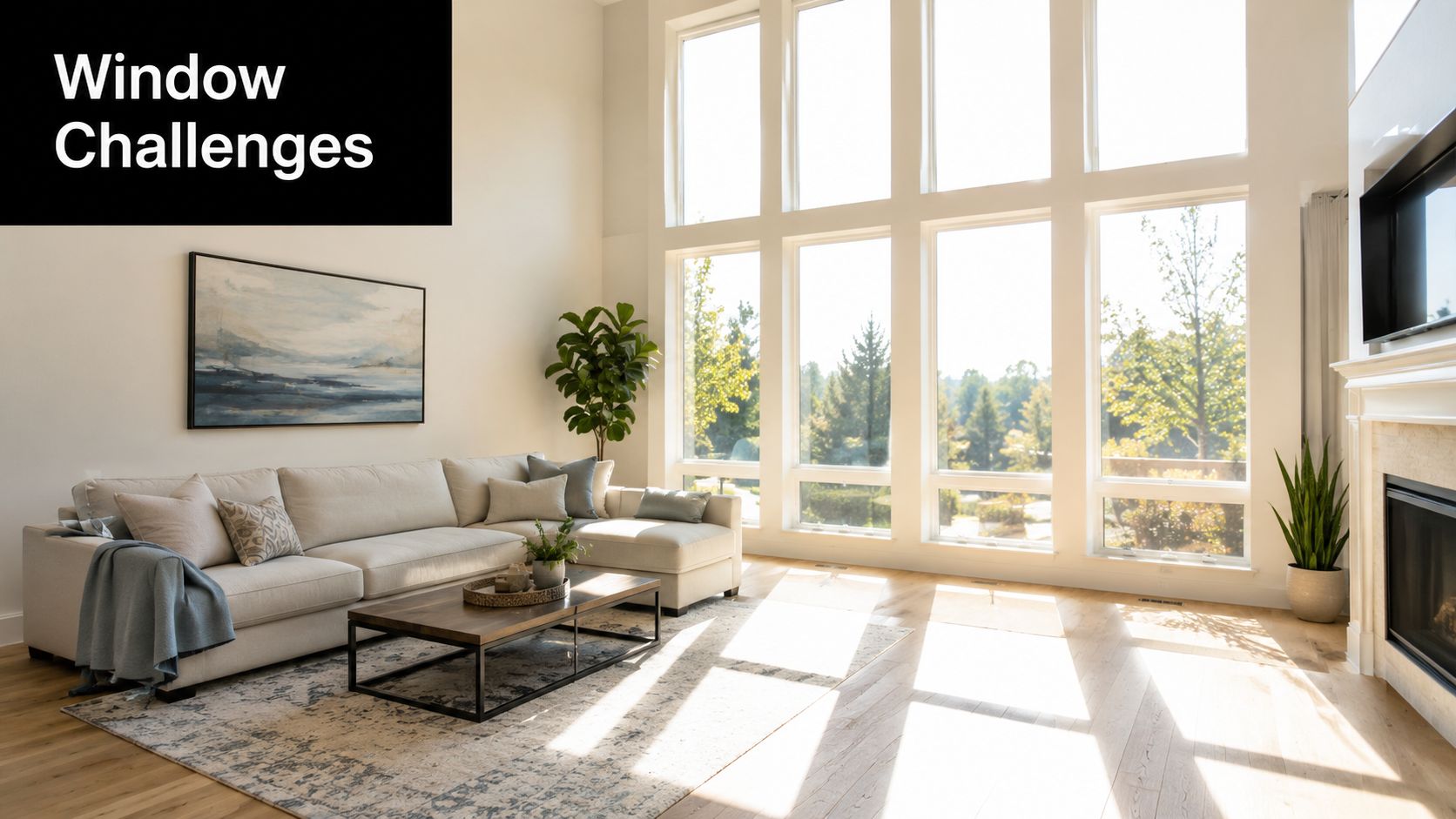
Large windows magnify small problems. A slight measuring error becomes a visible light gap. A bargain mechanism that works on a bedroom window starts binding on a wider opening. Fabrics that look smooth in a sample book can ripple or track poorly when they're pushed beyond what the hardware should carry.
The usual failure points
Most bad large-window setups fail in predictable ways:
- Too wide for the mechanism: The shade feels heavy, drifts, or stops rolling evenly.
- Not enough overlap: Light leaks at the sides, especially on outside mounts done too tight.
- Wrong product for the room: A sleek solar shade looks great until the streetlights switch on and privacy disappears.
- DIY measuring mistakes: The blind fits the tape measure, not the actual opening.
Big windows don't forgive shortcuts. The wider the opening, the more the little details matter.
Why custom matters in Ontario homes
You see this a lot in London and across Ontario. Builders like big patio doors, tall front windows, and open-concept living rooms with wide glass. Renovations add picture windows and larger openings too, especially where homeowners want more daylight.
That's why blinds for large windows are usually a custom job, not a grab-and-go purchase. The right answer depends on width, use, exposure, privacy needs, and whether the blind will be raised every day or mostly left in place.
What works is a product matched to the opening, measured properly, and installed with the final look in mind. That sounds basic, but it's where most frustration starts and where most of it can be avoided.
Choosing Your Champion The Best Blind Types for Wide Spans
Not every blind type belongs on a wide window. Some are better at preserving the view. Some handle daily use better. Some look clean from across the room but become annoying fast if they're too heavy or awkward to align.
What holds up on wide openings
For large spans, the strongest contenders are usually roller shades, zebra blinds, vertical blinds, and panel track blinds. They each solve a different problem.
One technical limit matters right away. For many roller and solar shades, a custom shade on a single headrail is practical only up to about 115 inches wide. Past that, suppliers often recommend splitting the opening into two or more shades to keep operation smooth and protect structural integrity, as explained in this guide to large window shade width limits.
Practical rule: If you're forcing one extra-wide shade to cover everything, you may be buying a future service call.
Large Window Blind Comparison
| Blind Type | Best For | Max Width Feel | Pros | Cons |
|---|---|---|---|---|
| Roller Shades | Picture windows, modern living rooms, offices | Clean and capable, but very wide spans often feel better split | Minimal look, easy to operate, good fabric range | Less flexible view/privacy control unless fabric choice is spot on |
| Zebra Blinds | Living rooms, front rooms, daytime privacy | Works well on large openings when sized properly | Adjustable light, modern look, softer feel than a plain roller | Not ideal if you want full blackout performance in every case |
| Vertical Blinds | Patio doors, sliders, very wide openings | Comfortable on width because the blind travels sideways | Practical for traffic areas, easy access through doors, good coverage | More utilitarian look, can feel less refined in some rooms |
| Panel Track Blinds | Wide patio doors, contemporary interiors | Designed for broad spans and large glass | Neat stacked panels, good for modern spaces, easy to pass through | Fewer style fits for traditional rooms, panel stack must be planned |
Where each option works best
Roller shades are often the safest modern choice for a big fixed window. They disappear neatly when open, don't fight the architecture, and come in fabrics from sheer to blackout. Where homeowners get into trouble is trying to make one oversized roller do too much. Past a certain width, splitting the treatment gives you a smoother result and usually a longer-lasting one.
Zebra blinds are popular because they give you more day-to-day control without looking busy. You can soften glare and still keep a sense of openness. They work well in rooms where people want flexibility more than darkness.
Vertical blinds still deserve more credit than they get. For sliding doors and high-traffic openings, they're practical, easy to live with, and forgiving on wider spans. They're not always the first pick for style-driven spaces, but they solve access problems better than many lift-up products.
Panel track blinds are a strong fit when the glass is wide and the room is contemporary. If you want to see how that system works on broad openings, panel track window blinds are one example of the format. They slide sideways in large panels, which often suits patio doors better than a shade that lifts.
A quick room-by-room rule helps:
- For fixed feature windows: Roller or zebra.
- For patio and sliding doors: Vertical or panel track.
- For frequent daily use: Prioritise easy operation over the smallest possible profile.
- For very wide spans: Accept that two coordinated blinds may outperform one oversized unit.
Light Privacy and View What Matters Most to You
People often start by asking about blind types. The better first question is simpler. What do you need this window to do every day?
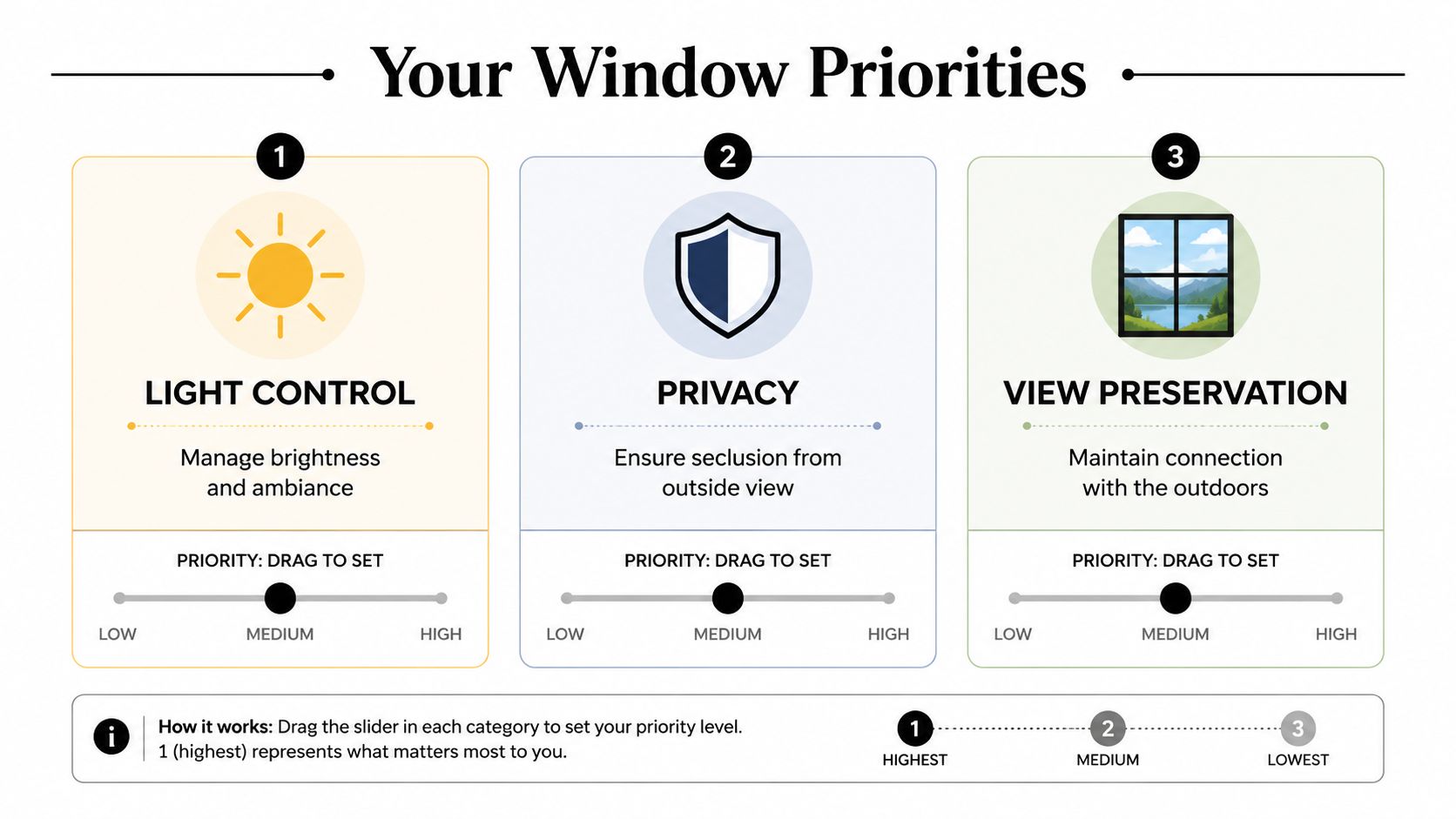
Start with the job the blind has to do
If the room overheats and the TV is hard to watch, light control comes first. If the window faces neighbours or the street, privacy comes first. If the whole reason for the big glass is the backyard, trees, or ravine, view preservation comes first.
Trying to max out all three usually leads to disappointment. A blackout material improves privacy and darkening, but it won't preserve a daytime view. A sheer or solar-style fabric keeps the room open and bright, but night privacy becomes limited once indoor lights are on.
A simple way to narrow the options
Use this quick filter:
- If glare is the main problem, look at light-filtering fabrics or adjustable designs like zebra blinds.
- If privacy is paramount, choose room-darkening or blackout-friendly materials and plan the mount carefully.
- If the view matters most, pick a treatment that lifts cleanly or filters light without visually chopping up the glass.
Zebra blinds are a good example of why this matters. They can shift between more open and more private settings, which suits living spaces where needs change through the day. They're less suited to rooms where you want theatre-dark conditions and the strongest possible edge coverage.
The right fabric usually matters more than the trendiest product name.
A second thing people miss is how the room is used after sunset. Daytime privacy and nighttime privacy are not the same. Plenty of large windows look perfect at noon and feel exposed at 9 p.m.
When homeowners rank their priorities, the options get easier fast:
- Family room: Usually glare and comfort first.
- Front sitting room: Privacy and softened daylight.
- Bedroom: Darkness and coverage.
- Dining area with a yard view: View first, then controlled light.
That approach saves a lot of backtracking. You stop shopping for every possible feature and start choosing the one outcome you care about most.
Go Smart The Guide to Motorized Blinds for Large Windows
Motorization used to be treated like an extra. On large windows, it's often just the practical way to run the blind.
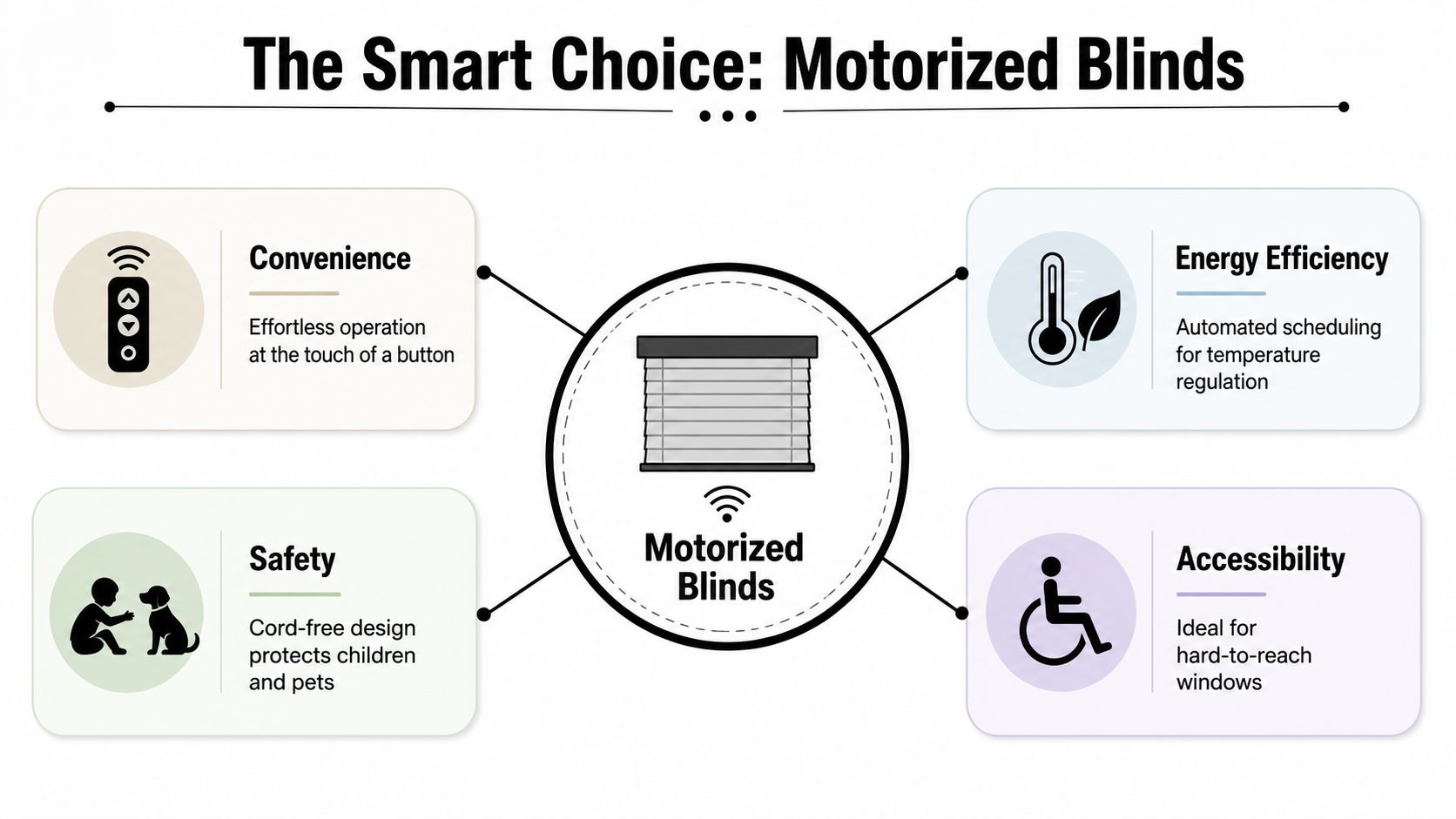
Why motorization makes sense on big glass
Wide shades are heavier. Tall shades are harder to reach. And when people have to tug, stretch, or line up multiple blinds by hand every day, they often stop adjusting them.
That pattern shows up in the data. A projected global market report said the blinds and shades market is expected to grow from US$7.51 billion in 2026 to US$9.85 billion by 2034, with about 3.5% CAGR, and the same source notes the U.S. Department of Energy found 75% of residential window coverings remain in the same position every day. For large windows, that's a strong argument for easier operation and automation, as covered in this motorized large-window blinds article.
The practical benefit is simple. If the blind is easy to use, people do use it.
Here's a quick look at motorized operation in action:
How people actually use it
Most homeowners fall into one of these setups:
- Remote control: Good for one room or a few large shades together.
- Wall switch: Useful when you want the control in the same place every time.
- App control: Handy for adjusting blinds without being in the room.
- Smart home integration: Best when you want routines, voice control, or grouped scenes.
For large windows, grouping matters. Two or three shades on the same wall look much better when they rise and lower evenly. That's hard to do manually. It's easy when they're paired electronically.
Motorization isn't about showing off. It's about making a heavy or awkward blind easy to live with for years.
If you're comparing systems, motorization for blinds shows the kind of control options available on custom setups.
Power and planning
Battery-powered motors are often the easiest fit in finished homes. They avoid opening walls and work well for many retrofit projects. Hardwired systems make more sense when you're building, renovating, or wiring several windows at once.
The best time to decide is before ordering, not after installation day. Motor choice affects wiring, charger access, cassette size, and how clean the final setup will look.
Getting the Perfect Fit Measurement and Mounting Explained
A large blind can be a good product and still look wrong if the measuring is off. Incorrect measuring often causes many DIY projects to go sideways.
Inside mount or outside mount
An inside mount sits within the window frame. It looks tidy and built-in, but it depends on having enough depth and a reasonably square opening. On large windows, that clean look is great when the frame cooperates.
An outside mount sits on the wall or trim around the opening. It gives better visual coverage, hides uneven frames, and usually blocks light more effectively at the edges. It's often the safer choice when the goal is coverage, not just minimalism.
How large windows should be measured
Standard practice is to measure the width in three places and the height in three places. For inside mounts, the narrowest width is typically used. For outside mounts, installers add overlap so the blind covers properly and doesn't leave harsh side gaps, as outlined in this measuring guide for custom blinds.
The same guide flags a window as out of square when the diagonal measurements differ by 1/4 inch or more. That matters more than people think. On a wide window, even a slightly skewed opening can make a blind look crooked or leave one corner with more light showing than the other.
A sensible measuring process looks like this:
- Check width top, middle, and bottom: Frames are often tighter in one spot than another.
- Check height left, centre, and right: Floors, headers, and trim aren't always perfectly aligned.
- Measure diagonals: This tells you whether the frame is square enough for a clean inside mount.
- Review obstructions: Handles, cranks, trim details, and nearby doors all affect fit.
If a large window is out of square, forcing an inside mount usually creates a problem you'll stare at every day.
If you're tempted to install it yourself, how to install custom blinds gives a sense of what's involved. The hard part usually isn't the bracket. It's getting the measurements and mount choice right before the product is made.
Beyond the Blinds Styling and Practical Extras
Once the blind type is chosen, the finish details decide whether the room looks complete or just covered.
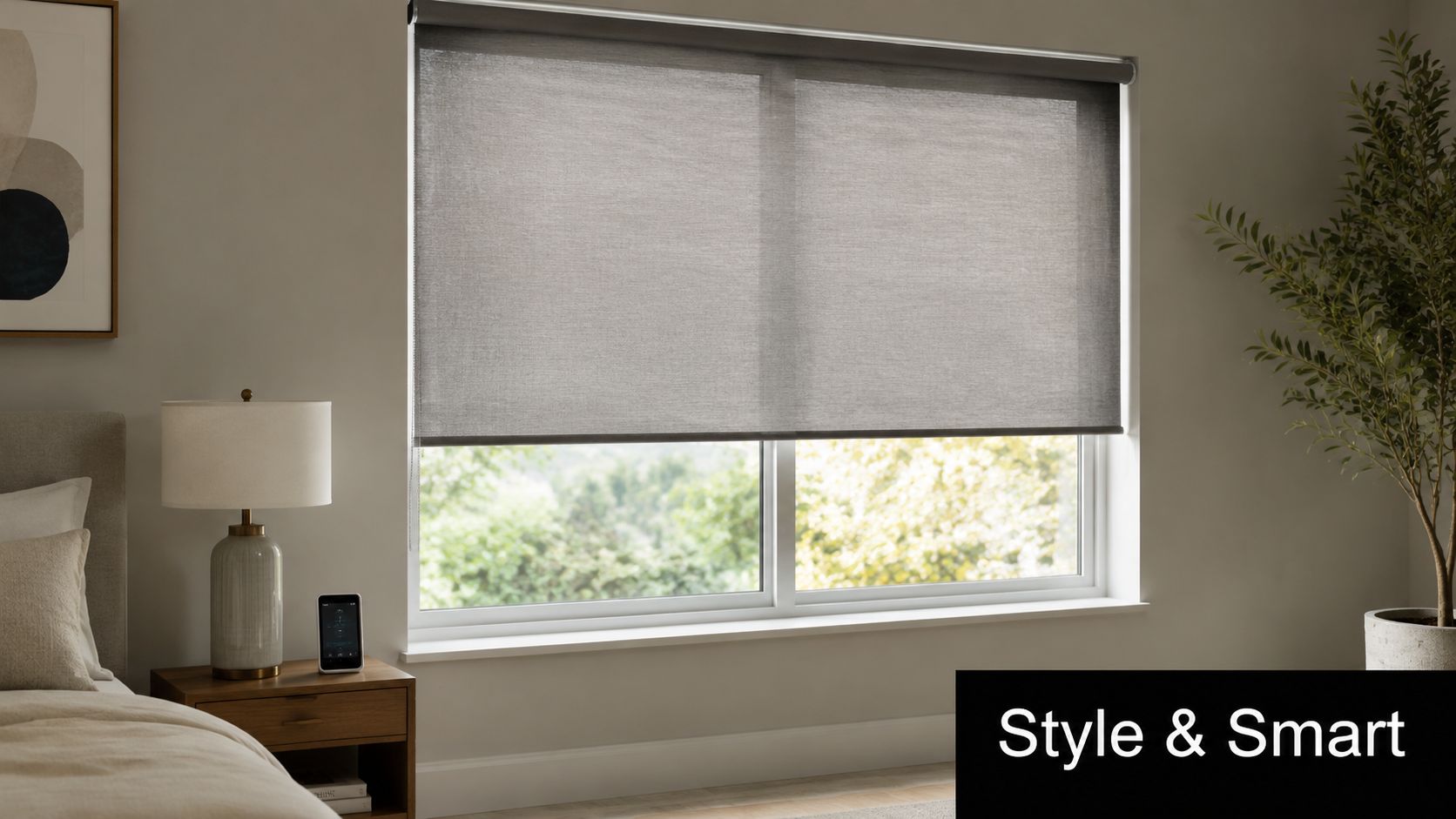
Finishing the room properly
Layering is one of the easiest upgrades. A roller or zebra blind handles light and privacy. Side panels or drapery add softness, height, and a more finished line across a big wall of glass.
Cassettes and valances matter too. A cassette wraps the top of the shade in a clean housing, while a valance hides hardware in a more traditional way. On wide windows, that top line is very visible, so the finishing detail has a bigger visual impact than many people expect.
Material choice also affects how the blind ages:
- Moisture-prone rooms: Avoid materials that don't love humidity.
- Strong sun exposure: Ask how the fabric and colour will handle daily UV.
- High-traffic doors: Choose something that can take regular movement without looking tired.
When the window shape changes everything
Some large windows aren't just wide. They're angled, arched, or topped with a gable shape. That changes the conversation completely.
Standard rectangular blinds won't fit large non-rectangular windows like angled-top styles. Those openings usually need a custom-cut treatment or a different product category entirely, as shown in these angle-top window treatment options.
That's why a generic blind list often fails people with feature windows over staircases, entryways, or vaulted living rooms. The question isn't “Which blind colour should I pick?” It's “Can this shape even take a standard operating product?”
If the answer is no, the best plan may be a fixed treatment, a specialty shade, or a layered solution that handles the rectangular lower section separately from the upper feature glass.
Making the Investment Cost and Finding the Right Partner
Large window coverings cost more because there's more going on. The opening is bigger, the hardware works harder, and mistakes are more expensive once the product is built. Add premium fabrics, motorization, cassettes, or specialty mounts, and the final price shifts quickly.
That's why it helps to think in terms of value, not just ticket price. Good blinds for large windows improve comfort, control glare, protect privacy, and make the room easier to use every day. A poor fit does the opposite. It looks off, wears faster, and leaves you annoyed every time the sun hits that wall.
A full-service local approach usually saves trouble in three places:
- Before ordering: Someone checks the room, the frame, and the specific operating needs.
- At measurement: The product is sized for the actual opening, not a guess.
- At installation: Alignment, bracket placement, and finishing details are handled properly.
For homeowners in London, Ontario, that kind of start-to-finish service matters more on big glass than on small windows. Large treatments leave less room for error and more to gain when the details are done right.
If you want help sorting out blinds for large windows in your home, Blinds Hut offers in-home consultations, custom measuring, installation, and made-to-measure options for wide windows, patio doors, and motorized setups in London, Ontario.