Perfect French Door Blinds: 2026 Guide for Your Home
French doors look great right up until real life starts happening. Afternoon glare hits the sofa, the patio faces the neighbour's yard, and in a London, Ontario winter you can feel the chill coming off the glass when you walk by.
That's why french door blinds need to do more than match the room. For homeowners in Ontario, the right window covering on a French door isn't just about style. It's about performance. NRCan notes that space heating is the dominant energy use in Canadian homes, and the right blinds can help reduce drafts and radiant chill from large glass doors, improving comfort and potentially lowering energy bills, as noted in this NRCan-based discussion on French door coverings in Canadian homes.
Table of Contents
- Finding Blinds for Your French Doors
- Why French Doors Need Special Blinds
- Exploring Your Blind Options for French Doors
- How to Measure French Doors for a Perfect Fit
- Hardware, Light Control, and Materials
- The Smart Upgrade Motorization for French Doors
- Choosing with Confidence The Blinds Hut Advantage
Finding Blinds for Your French Doors
The initial goal is often simple: to achieve privacy at night or reduce glare during the day, all while preserving the doors' appearance.
Then the practical issues show up fast. The handle sticks out. The frame is shallow. The blind bangs every time the door opens. In winter, the glass feels cold enough that the room never seems fully comfortable.
That's where generic advice usually falls short. A lot of guides talk about style first, but on a French door, fit and function come first. If the blind interferes with the handle or swings every time someone heads to the backyard, it won't matter how nice the fabric looks.
In a climate like London, Ontario, insulation matters more than many people expect. A treatment that sits neatly on the door and helps soften that cold-glass feeling can make the room feel more usable in January, not just more polished in June.
Practical rule: If a french door blind doesn't solve privacy, movement, and cold-glass comfort at the same time, it's usually the wrong product for the job.
The good news is that there are solid options. Some are better for energy performance, some are better for a slim modern look, and some are better when durability matters most in a busy family home.
The right choice usually comes down to four things:
- Door hardware: The handle and lockset decide how much profile depth you can get away with.
- Traffic level: A back patio door used all day needs a sturdier setup than a door opened once a week.
- Light needs: A kitchen door and a bedroom door usually need very different levels of privacy and light control.
- Seasonal comfort: In colder weather, insulating shades can feel noticeably better near the glass.
Why French Doors Need Special Blinds
French doors aren't just windows that happen to open. They move, they have hardware in the way, and they rarely give you much mounting depth to work with.
That combination is what makes off-the-shelf treatments unreliable on doors. A blind that works perfectly on a standard window can become annoying within a day on a French door.
The handle gets first say
The biggest problem is usually the handle. It projects out from the door and competes for the same space as the blind.
If the product is too deep, it rubs, catches, or won't lower properly. Even when it technically fits, repeated contact with the handle can wear the fabric, stress the brackets, or knock the treatment out of alignment over time.
The door is always moving
A regular window covering stays still. A door-mounted one travels every time someone goes outside, lets the dog out, or brings groceries in.
That movement changes what works. Heavier products can pull harder on the mounting points. Loose bottoms can swing. Wider stacks and bulkier headrails can feel clumsy on a narrow glass panel.
French door treatments need to stay controlled when the door moves, not just look good when the door is closed.
This is why secure bottom hardware matters so much on doors. If the lower part of the treatment isn't restrained, you'll hear it tapping the glass or the door panel.
The frame is often too shallow
Many French doors don't have enough recess for a true built-in look. Shallow frames, raised trim, and decorative moulding all limit what you can mount and where.
Industry guidance for French doors often points homeowners toward outside-mount solutions for exactly that reason. They give the treatment room to clear the hardware and cover the glass properly without fighting the shape of the door.
A few common mistakes show up again and again:
Choosing by style alone
A bulky blind may suit the room but still be wrong for the door.Ignoring projection depth
Width and height measurements aren't enough. The full depth of the product matters.Skipping door-specific hardware
A door blind usually needs bottom restraint so it won't swing during daily use.
When homeowners understand those three issues, the product choices get much easier. You stop asking, “What looks nice here?” and start asking, “What will fit, operate cleanly, and hold up on this door?”
Exploring Your Blind Options for French Doors
Some products are naturally better suited to French doors than others. The safest choices tend to be low-profile, lightweight, and easy to secure at the bottom.
Technical guides consistently recommend cellular shades as a top performer for French doors because they're lightweight, offer excellent insulation, and have a low-profile build that makes outside mounting easier around handles, as shown in Norman's French door treatment guidance.
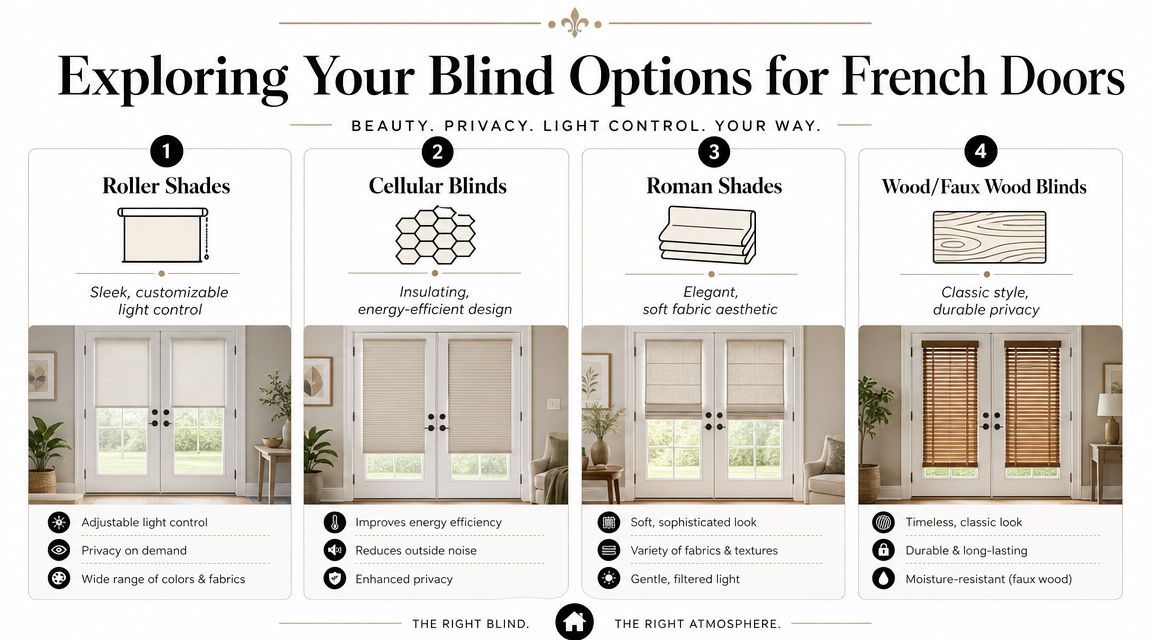
Roller shades
Roller shades are a clean, modern option. When they're open, they disappear neatly at the top. When they're down, they sit flat and simple against the glass.
They work well if you want a minimal look and straightforward operation. They're especially useful on doors where visual clutter is the main concern.
The trade-off is insulation. They can help with glare and privacy, but they won't usually give you the same cold-weather comfort as a cellular shade. If you're comparing fabrics and cassette styles, this guide to roller shades for custom window coverage is a useful reference.
Cellular shades
Cellular shades, also called honeycomb shades, are often the most practical answer for French doors in colder climates. Their structure is well suited to homeowners who want privacy, a slimmer profile, and better comfort near the glass.
They're also easier to live with on active doors because they're lightweight. Less weight usually means less strain on the mounting points and smoother day-to-day use.
For many homes, this is the option that balances the most needs at once:
- Insulation: Helpful when the glass feels cold in winter.
- Lower profile: Easier to clear handles and trim.
- Cleaner appearance: Softens the door without making it look bulky.
- Light control choices: Available in light-filtering or room-darkening styles.
Roman shades
Roman shades add softness that hard slats can't. If the room has upholstered furniture, warmer finishes, or a more decorative look, Roman shades can tie the space together nicely.
They can work very well on French doors, but they need careful product selection. Some Roman styles stack thicker at the top, and some fabrics feel heavier on a frequently used door. On a low-traffic door, that may be fine. On a busy patio exit, a lighter and flatter construction usually ages better.
A Roman shade can look tailored on a French door, but it has to be the right fold style and the right fabric weight.
Wood and faux wood blinds
Wood and faux wood blinds offer a familiar look and strong privacy control. They suit traditional interiors and can be a good match when nearby windows already use slatted blinds.
The trade-off is profile and movement. Slatted blinds generally project farther from the glass than a shade, and they can feel busier on a moving door. Faux wood is often the more practical version for doors because it handles wear better and is simpler to wipe down.
French Door Blind Comparison
| Blind Type | Best For | Light Control | Insulation | Profile |
|---|---|---|---|---|
| Roller Shades | Minimalist rooms, clean lines, simple privacy | Good, depends on fabric | Moderate | Low profile |
| Cellular Blinds | Cold-weather comfort, privacy, everyday use | Very good | Strong | Low profile |
| Roman Shades | Softer design, decorative spaces | Very good | Moderate, depends on fabric | Medium profile |
| Wood/Faux Wood Blinds | Traditional style, adjustable slats, durable wipe-clean finish | Very good | Moderate | Higher profile |
A simple way to narrow it down is to match the product to the problem. If winter comfort is the priority, cellular shades usually move to the top. If the room needs the cleanest possible look, roller shades often make more sense. If appearance matters more than stack depth, Roman shades can be a strong fit.
How to Measure French Doors for a Perfect Fit
Measuring a French door sounds simple until the handle gets involved. Most ordering mistakes happen because people measure the glass and forget the hardware, trim, or swing path.
The fit constraint that matters most is clearance around the door handle. Installation guidance states that most shades and blinds need at least 1 inch of clearance to fit behind a handle, which is critical if you want the treatment to operate properly and avoid damage during daily use, according to Blinds.com's French door measuring and fit guide.
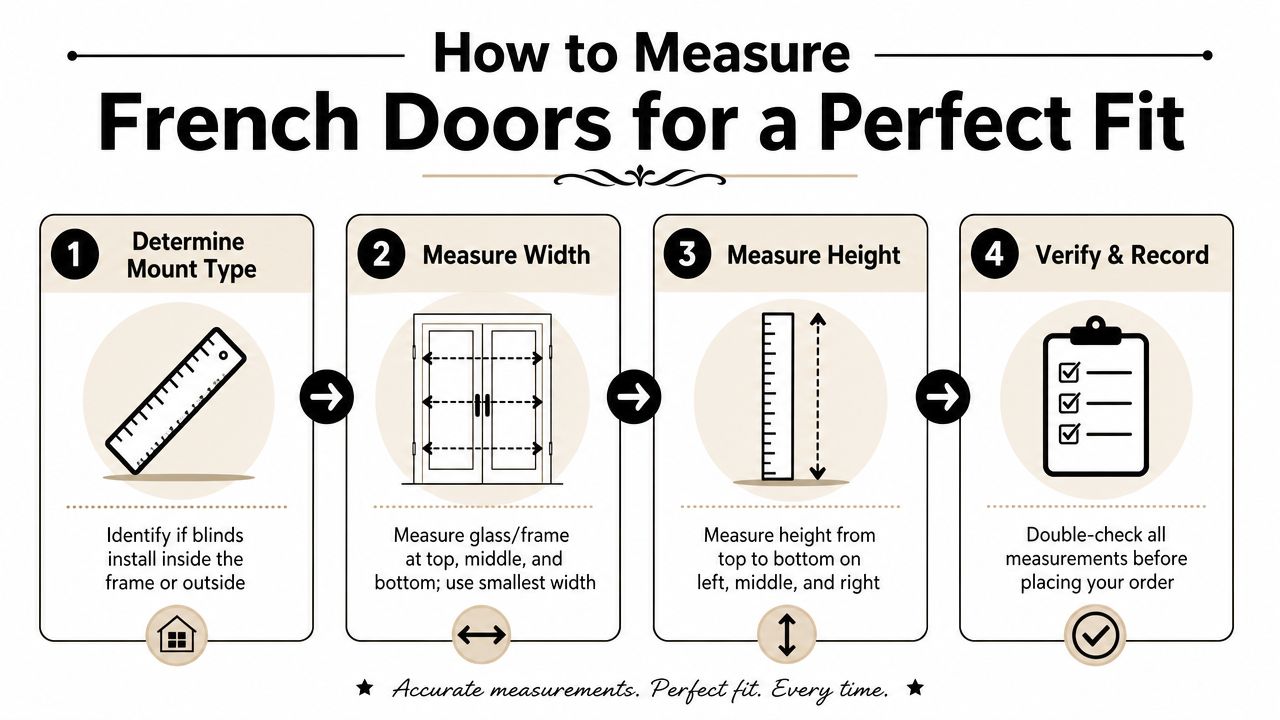
A visual guide helps before you start writing numbers down.
Inside mount or outside mount
An inside mount sits within the glass area or recessed part of the door. It can look tidy, but many French doors don't have enough depth for it.
An outside mount attaches on the face of the door or over the trim area around the glass. On French doors, this is often the safer option because it gives the blind space to clear the handle and cover the glass properly. If you want a quick visual on how recessed fit differs from surface fit, this inside mount reference for custom blinds helps clarify the idea.
What to measure before you order
Start with the glass area, but don't stop there. On a French door, width and height are only part of the job.
Check these points:
- Glass width in multiple spots: Measure top, centre, and bottom. Use the smallest reading if the area isn't perfectly square.
- Glass height in multiple spots: Measure left, centre, and right.
- Handle projection: Measure how far the handle sticks out from the door surface.
- Available flat mounting space: Make sure the bracket location is solid and not interrupted by moulding details.
- Door swing path: Open the door and notice anything nearby that could interfere with the blind when it's mounted.
After the basic measurements, watch this walkthrough if you want to see the process in action.
Why professional measuring helps
French doors punish small mistakes. A slight error in width can look uneven. A small misread on handle clearance can make the product unusable.
Professional measuring helps because the installer isn't just recording dimensions. They're reading the whole door as a working system, including trim shape, hardware projection, bracket placement, and how the selected product will behave once the door starts moving.
That's especially useful when the door has:
- Decorative trim that limits bracket placement
- Shallow rails around the glass
- A larger lever handle instead of a compact knob
- Two active doors that need to look balanced side by side
Hardware, Light Control, and Materials
Once you've picked the blind type and the mount, the smaller decisions shape how the door feels every day, turning a good-looking order into a practical one.
The hardware details that matter
The most overlooked item on a French door is the hold-down bracket. It secures the bottom of the treatment so it doesn't swing when the door opens and closes.
That sounds minor until you live with the alternative. A blind that taps the glass, twists slightly, or shifts every time someone uses the door gets annoying fast.
A stable door setup usually depends on these details:
- Hold-down brackets: Help keep the bottom rail controlled during movement.
- Low-profile headrails: Better for tight handle clearance.
- Secure mounting points: Important because doors move more than windows do.
- Smooth operating hardware: Makes daily use easier on busy entries.
Choosing the right light control
Light control isn't one setting. It's a choice between how much daylight you want, how much privacy you need, and how soft or firm you want the room to feel.
Light-filtering fabrics let daylight in while softening harsh sun. They work well on rear doors where you want brightness but don't want a direct view inside.
Room-darkening materials cut more light and give stronger privacy. They're often a good fit for rooms where sun glare hits screens or seating areas.
Blackout options are less common on French doors in main living areas, but they can make sense on doors near bedrooms or media spaces. The key is being realistic about edge light. On a door-mounted product, total darkness is harder to achieve than many homeowners expect because of the shape of the frame and the need for clearance.
Good fit beats perfect darkness: On a French door, a stable blind with the right privacy level usually performs better than a bulky blackout product that fights the hardware.
Materials that hold up better on doors
Doors are high-contact surfaces. That changes the material choice.
Cellular fabrics stay popular because they're light and efficient. Wood and faux wood products make sense when easy wipe-down maintenance matters more. Fabric shades suit softer rooms, but they need the right build so they don't feel heavy or overdone on the panel.
Energy-focused product advice has pushed many homeowners toward insulating shades for years. California's Title 24 energy code has long encouraged coverings that reduce solar heat gain and improve insulation, and for French doors that often means cellular shades are recommended for their high energy efficiency, as described in Hunter Douglas guidance on French door window treatments and energy performance. That same logic translates well to winter heat loss concerns in colder homes.
If you prefer a slatted look, this wood blinds buyer's guide for custom interiors is useful for comparing appearance, upkeep, and where real wood or faux wood makes the most sense.
For cleaning, keep it simple:
- Cellular shades: Dust gently and avoid crushing the cells.
- Roller shades: Wipe lightly with a soft cloth.
- Faux wood blinds: Dust, then spot-clean as needed.
- Fabric Romans: Follow the fabric care guidance and avoid over-wetting.
The Smart Upgrade Motorization for French Doors
Motorization sounds fancy, but on French doors it's often just practical. If the door gets used constantly, removing cords and repetitive tugging makes the treatment easier to use and easier to keep looking neat.
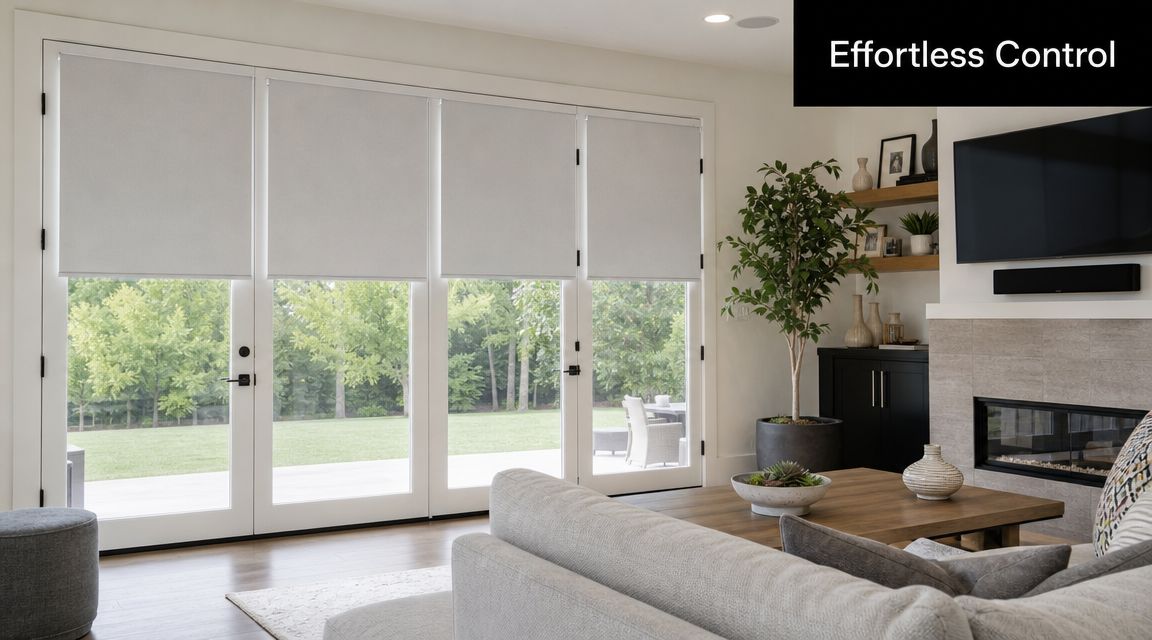
Why motorization makes daily use easier
A motorized shade reduces the little friction points that make people stop using their blinds properly. Instead of reaching around the handle, adjusting both doors by hand, or leaving one shade half-open all week, you press a button and the job is done.
That matters more on paired French doors than on a single window. Symmetry is easier to maintain, and the room looks more organised with less effort.
Motorization also helps with routine. You can lower the blinds in the evening for privacy, raise them in the morning for light, and keep the door area consistent without having to think about it every day.
Where it makes the biggest difference
Some homes benefit from motorization more than others. It's especially useful when:
- The doors are used often: Less wear from constant manual operation.
- There are two door panels: Easier to keep both shades aligned.
- The handle location is awkward: No reaching around hardware.
- The room changes light quickly: Fast adjustments make glare control simpler.
For homeowners already using smart speakers or app-based controls in the home, motorized treatments can feel like a natural extension rather than a tech project. The setup is usually most appreciated in living rooms, patio doors, and rear entries where privacy and daylight change throughout the day.
Choosing with Confidence The Blinds Hut Advantage
By the time most homeowners finish comparing products, they've usually figured out one thing. French door blinds aren't hard because there are too many choices. They're hard because the wrong half-inch in the wrong place can ruin the result.
That's why the process matters as much as the product. Good advice means matching the blind to the handle clearance, the traffic level, and the room's comfort needs, not just handing over a sample book.
What a smoother process looks like
For a local homeowner, a smoother project usually looks like this:
- See materials at home: Samples look different beside your flooring, paint, and door trim than they do in a showroom.
- Measure the actual door conditions: Hardware, moulding, glass size, and swing all get checked together.
- Choose the right operating style: Lightweight shades, hold-down hardware, or motorization are determined.
- Install for clean operation: The blind should clear the handle, sit level, and stay controlled when the door moves.
One option in London is Blinds Hut, which provides in-home consultations, made-to-measure products, measurement, and installation for custom blinds, shades, and shutters. That kind of end-to-end approach is useful on French doors because fit issues usually show up before ordering, not after installation.
A well-planned order feels simple once it's finished. The blind sits properly, the door opens cleanly, privacy is there when you need it, and the room feels more comfortable in every season.
If you want help choosing french door blinds that fit your handles, suit your room, and make sense for London winters, book a consultation with Blinds Hut. You can get advice based on your actual doors, your light needs, and the look you want, without guessing your way through measurements or product depth.
Written with Outrank app