Panel Track Window Blinds: Your Complete Buying Guide
If you're staring at a sliding patio door with tired verticals, heavy drapes, or nothing at all because every option feels wrong, you're not alone. Large openings are awkward to cover well.
Standard blinds often look too busy. Curtains can feel bulky, drag on the floor, and get pushed around every time someone heads out to the deck.
That's where panel track window blinds make a lot of sense. They give you the clean lines people like in modern shades, but they're built for wide openings that ordinary blinds don't handle gracefully. They also hold up well in homes where the door gets used all day, which matters a lot more than showroom style.
Table of Contents
- Tired of Awkward Coverings for Your Sliding Door
- What Are Panel Track Blinds and Where Do They Shine
- Panel Tracks vs Vertical Blinds and Curtains
- Designing Your Blinds Fabric Materials and Styles
- Measuring and Mounting for a Perfect Fit
- Care Maintenance and Smart Home Upgrades
- Get it Right The Blinds Hut Custom Experience
- Frequently Asked Questions About Panel Track Blinds
Tired of Awkward Coverings for Your Sliding Door
A sliding door creates two problems at once. You need privacy, and you need something that can move out of the way easily every single day.
That's why so many homeowners get stuck between options they don't love. Vertical blinds are practical, but many people are ready to move on from the office look. Curtains soften a room, but in a busy family space they can collect dust, bunch up behind furniture, and end up feeling like more fabric than function.
Panel track window blinds fill the gap between those two. They look cleaner than old verticals and feel more refined than a basic curtain panel. Instead of lots of narrow slats, you get broad panels that slide across a track in a smooth, simple motion.
For a patio door, that matters. You want coverage when it's closed, and quick access when someone needs to step outside with groceries, let the dog out, or carry drinks to the backyard.
Why people switch to panel tracks
- Cleaner sight lines: Fewer vertical lines make a wide opening look calmer and more organised.
- Better everyday movement: Broad panels slide as a group, so the treatment feels less fiddly.
- A more current look: They suit newer homes, condo units, and updated renovations especially well.
- Less visual clutter: On a big opening, they usually look more intentional than layering rods, rings, and fabric.
Practical rule: If the opening is wide and gets used often, choose the treatment that creates the least fuss on a busy day, not the one that only looks good in a staged photo.
A lot of people haven't heard of panel tracks until they start shopping seriously. Once they see them in person, the reaction is usually immediate. This is what they wanted all along, they just didn't know the category had a name.
What Are Panel Track Blinds and Where Do They Shine
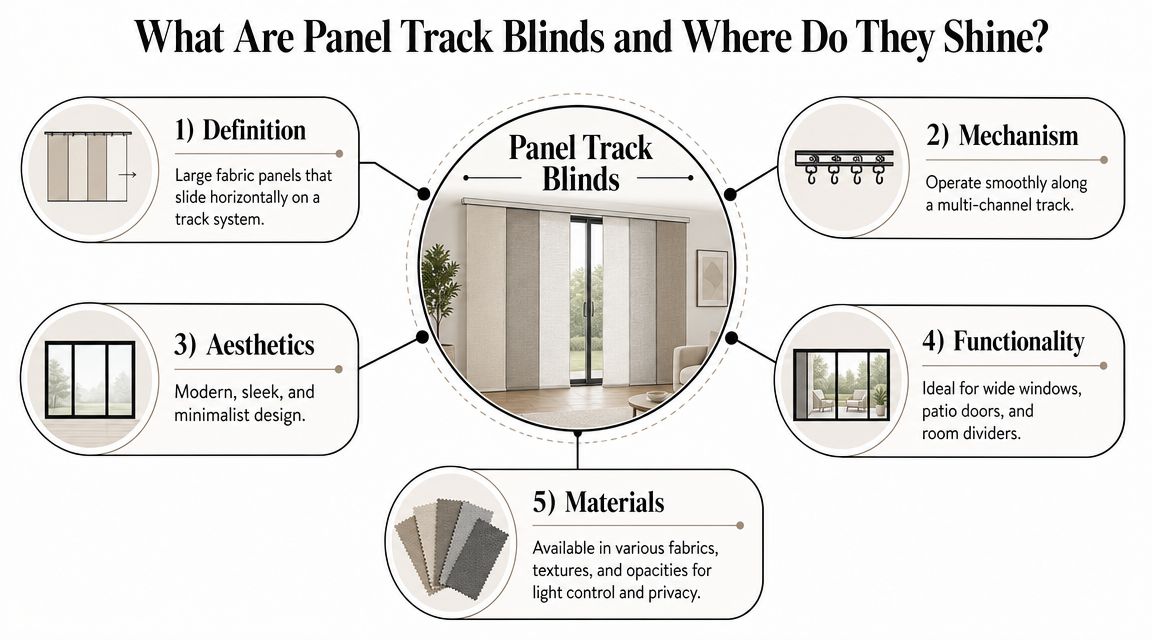
Panel track blinds are best thought of as sliding panels for windows and doors. Instead of narrow slats that tilt, they use wide fabric panels that glide side to side on a track.
In Canada, they're understood as a modern adaptation of large-format window coverings for wide openings like sliding glass doors and patio doors. Industry guidance also notes panel widths often range from about 12 to 20 inches for large-span coverage and a precise fit, as explained in this panel track blinds overview from Blindsgalore.
The basic idea
Think of them like closet doors, but lighter and softer. Each panel hangs from its own channel, and the panels overlap as they pass one another.
That overlap is a big part of why they work well. It helps with privacy and light control, especially on a bright patio door where gaps can become annoying fast.
They also sit nicely in rooms where you want a simple, modern finish. The flat face of the panel shows off texture and fabric better than a narrow louvre ever could.
Where they work best
Panel tracks shine in places where standard blinds start to look too chopped up.
A few strong uses stand out:
- Sliding glass doors: This is the most natural fit. They open in the same direction people move.
- Patio doors: Easy access matters here, and broad panels feel less fragile in daily use.
- Oversized windows: Large picture windows look more balanced with wider coverage.
- Room dividers: In open spaces, panel tracks can separate zones without adding a heavy built wall feel.
Wide openings need a treatment designed for wide openings. That sounds obvious, but it's the mistake people make most often.
They're also a good answer when someone wants the softness of fabric without committing to full drapery. You still get texture and warmth, but in a more structured form.
What they don't do as well is mimic the tight vane adjustment of a traditional slatted blind. If you want frequent fine-tuned tilting throughout the day, another product may suit you better. But if your real need is broad coverage, clean movement, and a tidy look across a large opening, panel tracks are in their element.
Panel Tracks vs Vertical Blinds and Curtains
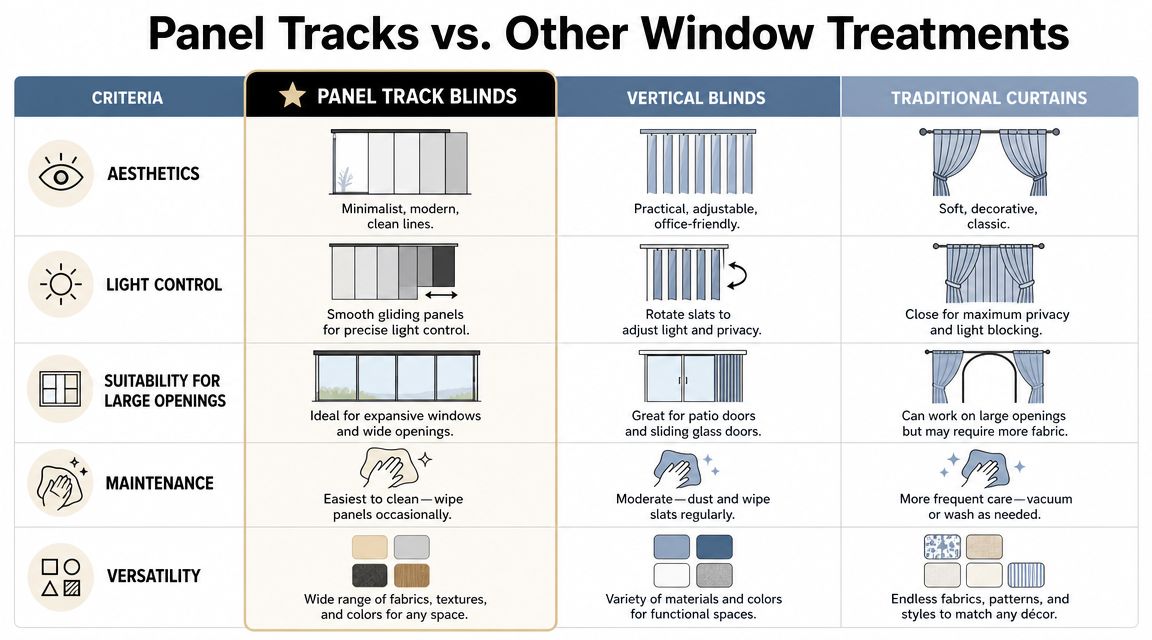
The decision usually becomes clearer at this point. Those comparing panel tracks are really choosing between panel tracks, vertical blinds, and curtains for the same large opening.
The right answer depends less on trend and more on how the space gets used. A formal dining room has different demands than a rental unit, and a family patio door has different demands than a quiet guest room.
How they compare in daily use
| Option | Best at | Trade-off |
|---|---|---|
| Panel tracks | Clean look, wide openings, smooth side-to-side use | Less suited to people who want slat-by-slat adjustment |
| Vertical blinds | Straightforward function and familiar operation | Can look dated depending on the room |
| Curtains | Softness, fullness, decorative impact | More fabric to manage, clean, and keep neat |
Vertical blinds still have a place. They're useful, widely understood, and easy to operate. If you want a more detailed look at where they fit, this guide on the benefits of vertical blinds for your home is worth reading.
Curtains win when softness is the top priority. They can make a room feel finished, but they also bring more material, more hardware, and more movement around the opening. In high-traffic spaces, that can become irritating.
Where panel tracks pull ahead
Panel tracks tend to do especially well where the opening gets handled constantly. That includes family homes, rentals, senior living situations, and commercial interiors where people need something easy to use.
A useful point from Ontario-focused guidance is that panel track systems have an advantage in rentals, senior settings, and high-traffic commercial spaces because of their easy-glide, low-force operation and the possibility of replacing individual fabric panels rather than the entire treatment, as noted in this panel track systems article from The Shade Store.
That matters in real life.
- For rentals: A damaged panel is often easier to deal with than replacing a whole soft treatment setup.
- For seniors: Smooth operation can be more important than decorative extras.
- For busy households: Fewer fussy parts usually means fewer complaints.
Here's the honest trade-off. If you love a layered, luxurious window with puddled fabric and decorative hardware, panel tracks won't give you that. They're neater, flatter, and more architectural.
If you hate the clatter and visual busyness of older verticals, panel tracks are often the better compromise. They still suit a broad opening, but they look more current and feel more composed.
Designing Your Blinds Fabric Materials and Styles
Once the format is right, the fabric choice decides how the room feels. This is the part people often rush, but it has the biggest effect on glare, privacy, and the mood of the space.
The same panel track can read crisp and minimal, warm and textured, or soft and quiet depending on the material. That's why it helps to start with the room's function before you start talking about colour.
Choose fabric based on the room first
For a bright patio door or sun-filled family room, solar-style fabrics are often a smart choice. They help soften glare and keep the opening from feeling too exposed, while still keeping the room visually open.
For bedrooms or media rooms, room-darkening or blackout-style fabrics make more sense. They create a more controlled environment and give stronger privacy when the room needs to shut out light.
Natural-looking woven textures work well when you want warmth. They can soften a modern room without making it feel heavy.
From a practical standpoint:
- Light-filtering fabrics: Good for living spaces where you want daylight without a harsh wash of sun.
- Room-darkening fabrics: Better when privacy and reduced brightness matter more than maintaining a bright daytime look.
- Screen-style fabrics: Useful where glare control is the main issue.
- Textured woven looks: Best when the treatment needs to add character, not just coverage.
Choose the fabric for what the room does at 7 a.m. and 7 p.m., not just for how the sample looks at noon.
Colour comes after function. Neutrals are easier to live with long-term, especially on a large opening. Texture usually gives a better result than a loud pattern because these panels cover a lot of visual space.
Why panel width changes the whole look
Panel width is not just a technical factory detail. It changes the appearance and the way the treatment stacks when open.
Industry guidance notes that panel width typically ranges from 15 to 26 inches, and the final panel count is based on the opening size so the stack-back doesn't interfere with door operation or the view, according to this panel track design guide from Hunter Douglas.
That has a few real-world effects:
- Wider panels: Fewer seams, cleaner look, bigger stack when open.
- Narrower panels: More divisions across the opening, smaller visual blocks, different stack behaviour.
- Panel count: Affects how much of the glass stays visible when the blinds are fully open.
If you have furniture near the door, stack-back matters even more. A beautiful fabric won't help if the parked panels interfere with handles, traffic flow, or the opening side of the door.
For homeowners trying to tie all these details together, this piece on custom blinds and shades design ideas can help you think through the look before you order.
Style choices that usually age well
The safest long-term choices are often the simplest.
A few combinations tend to work especially well:
- Soft white or warm grey fabric: Clean, flexible, and easy to pair with changing décor.
- Subtle texture with a flat panel face: Adds interest without making the opening too busy.
- Matte hardware finishes: Keeps the treatment from looking overly mechanical.
- Minimal pattern: Better on large expanses where repeated motifs can feel oversized fast.
What usually doesn't work is over-designing a hard-working opening. The patio door in a busy home should first be easy to use, easy to live with, and pleasant to look at every day.
Measuring and Mounting for a Perfect Fit
A sliding door gets used hard in some homes. Kids run in and out to the yard, guests grab the nearest panel instead of the lead carrier, and in rentals, nobody treats the blinds gently. If the measurements or mount choice are off, panel tracks start feeling awkward fast. They drag, stack in the wrong spot, or leave gaps that annoy people every day.
Inside mount or outside mount
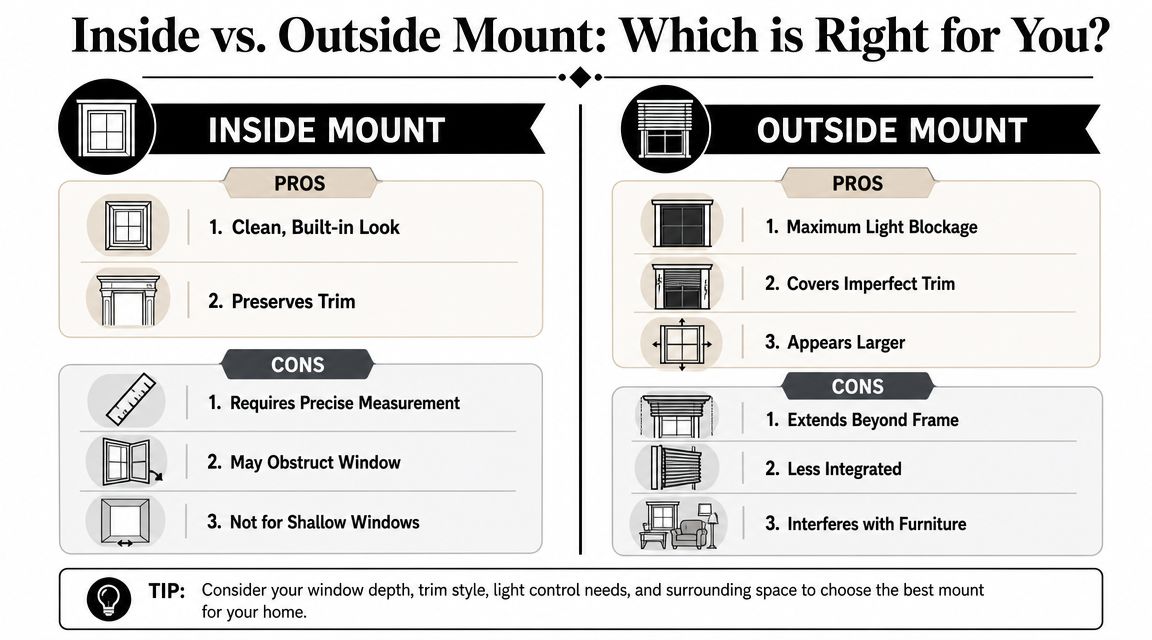
An inside mount gives a cleaner built-in look, but it asks more from the opening. The frame needs enough depth, and it helps if the jamb is fairly straight. In older homes, I often find that the opening looks square until you put a tape on it.
An outside mount is usually more forgiving. It helps cover uneven trim, gives better edge coverage, and often works better on busy patio doors where function matters more than a recessed look. In rentals and high-traffic family spaces, that extra coverage can make the door easier to live with because users notice fewer side gaps and alignment issues.
If you're weighing that recessed style against the space you have, this guide to inside mount blinds gives a good quick reference.
How to measure without creating problems later
Panel tracks need accurate width, enough stack room, and a mounting surface that stays level across the span. Small mistakes show up right away on a wide treatment.
The basic measuring rules are straightforward. Use a steel tape, record width before height, and round to the nearest 1/8 inch. For inside mounts, measure the width at the top, centre, and bottom, then use the smallest number. Measure the height at the left, centre, and right, then use the largest number. For outside mounts, order the size you want the blind to cover, with roughly 1.5 inches of overlap per side for better coverage, as outlined in this panel track measuring guide from American Blinds.
Before you measure, it helps to see the parts in motion:
Here's the short checklist I use on site:
- Use a steel tape. Soft tape measures and loose tape hooks can throw off a wide opening.
- Measure every point. Patio door openings are often out of square, especially in older houses, basement walkouts, and quick renovation jobs.
- Confirm the stack side first. The open panels should not cover the handle, crowd the walkway, or block the active side of the door.
- Check for obstacles. Locks, trim, baseboard heaters, nearby furniture, and alarm sensors all affect where the track should sit.
- Make sure the mounting surface is solid and level. A long track installed slightly off level will never feel right in daily use.
One mistake causes more trouble than people expect. They measure the opening, but not the room around the opening. A panel track can fit the width on paper and still be a poor install if the stacked panels hit a sofa arm, land in front of a light switch, or park where people brush against them every time they head outside.
If the opening is even a little out of square, an inside mount only works when you size to the smallest width. That can leave more visible light gap at one side, but it is still better than ordering a track that binds inside the frame.
Good measuring protects more than appearance. It affects how long the system stays easy to use, especially in homes and rentals where the door gets opened over and over every day.
Care Maintenance and Smart Home Upgrades
Panel tracks are one of the easier large-opening treatments to live with, as long as you treat them like fabric panels on a moving system, not like something you can shove aside with your shoulder on the way to the deck.
Daily care is simple. Most of the time, dust is the only thing building up.
Keeping them looking good
A light routine works better than occasional aggressive cleaning. Dust the panels gently or use a soft brush vacuum attachment when needed.
Spot cleaning should stay gentle too. Blot, don't scrub. Scrubbing can rough up the fabric face or leave a visible patch once it dries.
A few habits make a difference over time:
- Slide them by the proper control or leading panel: Don't yank random panels out of alignment.
- Keep the track clear: Debris in the track can make operation feel rough.
- Watch high-touch edges: The panel nearest the handle side often gets the most fingerprints.
- Fix small issues early: A panel sitting slightly off can usually be corrected before it becomes wear.
For rental properties or busy family spaces, one practical advantage is that panel systems can be easier to keep serviceable because the components are straightforward and the overall design is less fussy than layered drapery setups.
When motorization is worth it
Motorization makes the biggest difference on large or frequently used openings. It's less about novelty and more about convenience.
If the door is tall, wide, or used throughout the day, a remote or wall control keeps operation consistent. That can be helpful in homes with mobility concerns, in condos with large glazed doors, or in spaces where people want the treatment opened and closed without handling the fabric.
Smart home integration adds another layer of convenience. Scheduling the blinds to open in the morning or close in the evening can make a room feel more polished in daily use.
This upgrade isn't necessary for everyone. If the opening is modest and easy to reach, manual operation is often perfectly fine. But on a big patio door that gets constant use, motorization can be one of the few upgrades you notice and appreciate right away.
Get it Right The Blinds Hut Custom Experience
Large openings are where custom work earns its keep. Panel tracks look simple once they're installed, but getting them right takes good measuring, smart fabric selection, and proper stack planning.
That's why a full-service process matters. Seeing samples in your own light tells you more than any showroom wall ever will, especially with textured fabrics and privacy levels that change throughout the day.
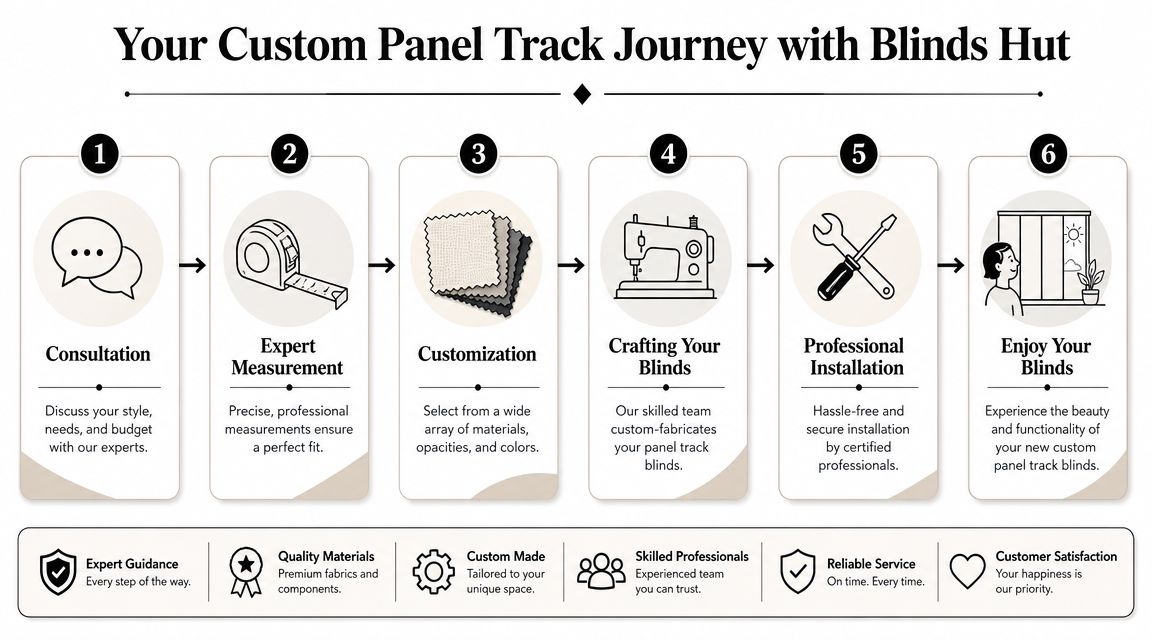
A strong custom experience should include a few essential elements:
- In-home consultation: The opening, traffic flow, and furniture layout all affect the right setup.
- Accurate measurement: This is what separates smooth operation from constant annoyance.
- Fabric guidance: A good fabric isn't just attractive. It has to suit privacy, glare, and wear.
- Professional installation: A level track and clean finish matter on a treatment this visible.
For homeowners, landlords, and renovators, this removes the guesswork. Instead of trying to reverse-engineer panel count, stack-back, and mount choices from product pages, you get a treatment built around the actual room.
The end result should feel easy. The panels should move smoothly, stack where they're supposed to, and suit the space without calling attention to the mechanics.
Frequently Asked Questions About Panel Track Blinds
A few questions come up in almost every consultation, especially when someone is considering panel tracks for the first time.
Quick Answers to Common Questions
| Question | Answer |
|---|---|
| Are panel track blinds only for patio doors? | No. They're also a good fit for oversized windows and can work as room dividers in some layouts. |
| Are they good for rentals? | They can be a smart choice in rentals because they're straightforward to operate and often easier to keep looking tidy than heavier soft treatments. |
| Do they block all light? | That depends mostly on the fabric and the mount choice. Some fabrics soften light, while others provide much stronger room-darkening performance. |
| Are they safe and easy for seniors to use? | They can be a practical option because the operation is smooth and low effort when properly specified and installed. |
| Do panel tracks look too modern for traditional homes? | Not always. Fabric choice makes a big difference. A soft texture or neutral weave can help them sit comfortably in a more classic room. |
| Are they hard to clean? | Usually not. Regular dusting and light spot cleaning handle most of the upkeep. |
If you're covering a wide opening, the best choice usually comes down to how the space gets used every day. Style matters, but ease of use matters more once you've lived with the treatment for a month.
If you're ready to sort out a sliding door or oversized window properly, Blinds Hut can help with in-home advice, fabric samples, precise measuring, and professional installation across London, Ontario. It's a straightforward way to get custom panel track blinds that fit cleanly, operate smoothly, and suit the way your space works.
Enhanced by Outrank